Autocorrelation
EC 421, Set 8
Prologue
Schedule
Last Time
Introduction to time series
Today
Autocorrelation
R showcase
Functions
Writing your own functions.
Writing functions
Functions are everywhere
Everything you do in R involves some sort of function, e.g.,
mean()lm()summary()read_csv()ggplot()+
The basic idea in R is doing things to objects with functions.
Writing functions
Functions can help
We write functions to make life easier. Instead of copying and pasting the same line of code a million times, you can write one function.
In R, you use the function() function to write functions.1
the_name: The name we are giving to our new function.arg1: The first argument of our function.arg2: The second argument of our function.
Writing functions
Our first real function
Let’s write a function that multiplies two numbers. (It needs two arguments.)
Did it work?
Writing functions
Functions can do anything
… that you tell them.
If you are going to repeat a task (e.g., a simulation), then you have a good situation for writing your own function.
R offers many functions (via its many packages), but you will sometimes find a scenario for which no one has written a function.
Now you know how to write your own.
Writing functions
Time series
Review
Time series
Review
Changes to our model/framework.
Our model now has \(\textcolor{#e64173}{t}\) subscripts for time periods.
Dynamic models allow lags of explanatory and/or outcome variables.
We changed our exogeneity assumption to contemporaneous exogeneity, i.e., \(\mathop{\boldsymbol{E}}\left[ u_t \middle| X_t \right] = 0\)
Including lags of outcome variables can lead to biased coefficient estimates from OLS.
Lagged explanatory variables make OLS inefficient.
Autocorrelation
Autocorrelation
What is it?
Autocorrelation occurs when our disturbances are correlated over time, i.e., \(\mathop{\text{Cov}} \left( u_t,\, u_s \right) \neq 0\) for \(t\neq s\).
Another way to think about: If the shock from disturbance \(t\) correlates with “nearby” shocks in \(t-1\) and \(t+1\).
Note: Serial correlation and autocorrelation are the same thing.
Why is autocorrelation prevalent in time-series analyses?
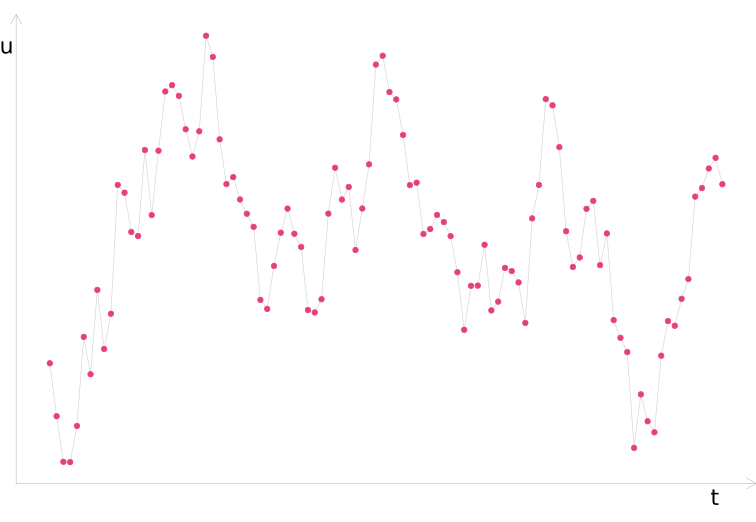
Positive autocorrelation: Disturbances \(\left( u_t \right)\) over time
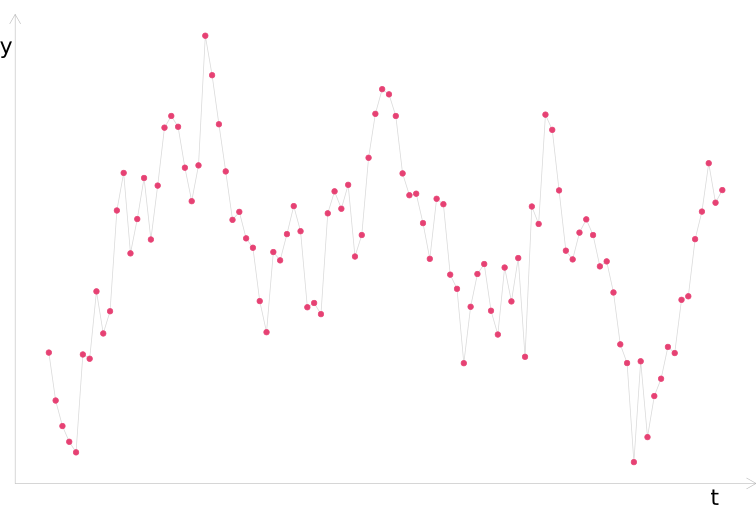
Positive autocorrelation: Outcomes \(\left( y_t \right)\) over time
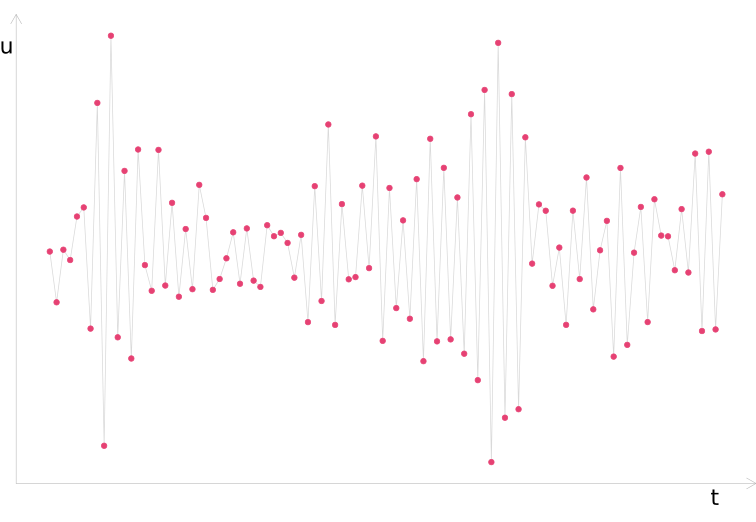
Negative autocorrelation: Disturbances \(\left( u_t \right)\) over time
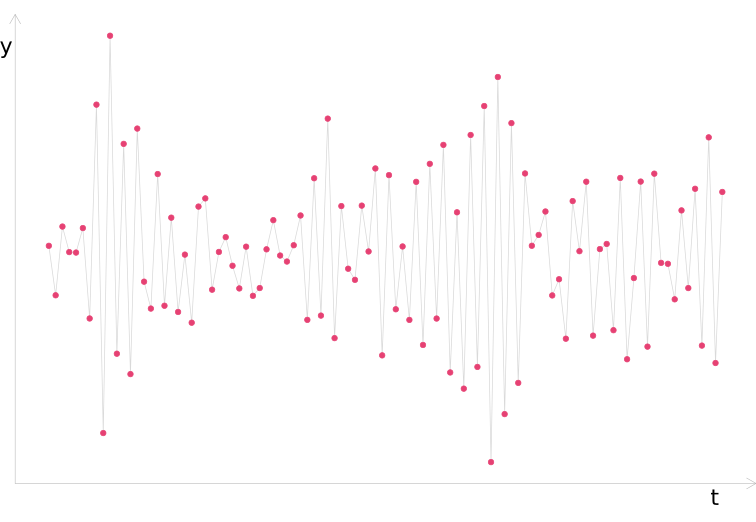
Negative autocorrelation: Outcomes \(\left( y_t \right)\) over time
Autocorrelation
In static time-series models
Let’s start with a very common model: a static time-series model whose disturbances exhibit first-order autocorrelation, a.k.a. AR(1):
\[ \begin{align} \text{Births}_t &= \beta_0 + \beta_1 \text{Income}_t + u_t \end{align} \] where \[ \begin{align} \textcolor{#e64173}{u_t} = \textcolor{#e64173}{\rho \, u_{t-1}} + \varepsilon_t \end{align} \] and the \(\varepsilon_t\) are independently and identically distributed (i.i.d.).
Second-order autocorrelation, or AR(2), would be
\[ \begin{align} \textcolor{#6A5ACD}{u_t} = \textcolor{#6A5ACD}{\rho_1 u_{t-1}} + \textcolor{#6A5ACD}{\rho_2 u_{t-2}} + \varepsilon_t \end{align} \]
Autocorrelation
In static time-series models
An AR(p) model/process has a disturbance structure of
\[ \begin{align} u_t = \sum_{j=1}^\textcolor{#20B2AA}{p} \rho_j u_{t-j} + \varepsilon_t \end{align} \]
allowing the current disturbance to correlated with up to \(\textcolor{#20B2AA}{p}\) of its lags.
Autocorrelation
OLS
For static models or dynamic models with lagged explanatory variables, in the presence of autocorrelation
OLS provides unbiased estimates for the coefficients.
OLS creates biased estimates for the standard errors.
OLS is inefficient.
Recall: Same implications as heteroskedasticity and correlated disturbances.
(Correlated disturbances are actually what we have with autocorrelation.)
However, autocorrelation get trickier with lagged outcome variables.
Autocorrelation
OLS and lagged outcome variables
Consider a model with one lag of the outcome variable—ADL(1, 0)—model with AR(1) disturbances
\[ \begin{align} \text{Births}_t = \beta_0 + \beta_1 \text{Income}_t + \beta_2 \text{Births}_{t-1} + u_t \end{align} \] where \[ \begin{align} u_t = \rho u_{t-1} + \varepsilon_t \end{align} \]
Problem: \(\text{Births}_{t-1}\) (a regressor in the model for time \(t\)) and
\(u_{t}\) (the disturbance for time \(t\)) both depend upon \(u_{t-1}\).
I.e., a regressor is correlated with its contemporaneous disturbance.
Q: Why is this a problem?
A: It violates contemporaneous exogeneity, i.e., \(\mathop{\text{Cov}} \left( x_t,\,u_t \right) \neq 0\).
Autocorrelation
OLS and lagged outcome variables
To see this problem, first write out the model for \(t\) and \(t-1\): \[ \begin{align} \text{Births}_t &= \beta_0 + \beta_1 \text{Income}_t + \beta_2 \text{Births}_{t-1} + u_t \\ \text{Births}_{t-1} &= \beta_0 + \beta_1 \text{Income}_{t-1} + \beta_2 \text{Births}_{t-2} + u_{t-1} \end{align} \] and now note that \(u_t = \rho u_{t-1} + \varepsilon_t\). Substituting… \[ \begin{align} \text{Births}_t &= \beta_0 + \beta_1 \text{Income}_t + \beta_2 \textcolor{#6A5ACD}{\text{Births}_{t-1}} + \overbrace{\left( \rho \textcolor{#e64173}{u_{t-1}} + \varepsilon_t \right)}^{u_t} \tag{1} \\ \textcolor{#6A5ACD}{\text{Births}_{t-1}} &= \beta_0 + \beta_1 \text{Income}_{t-1} + \beta_2 \text{Births}_{t-2} + \textcolor{#e64173}{u_{t-1}} \tag{2} \end{align} \]
In \((1)\), we can see that \(u_t\) depends upon (covaries with) \(\textcolor{#e64173}{u_{t-1}}\).
In \((2)\), we can see that \(\textcolor{#6A5ACD}{\text{Births}_{t-1}}\), a regressor in \((1)\), also covaries with \(u_{t-1}\).
∴ This model violates our contemporaneous exogeneity requirement.
Autocorrelation
OLS and lagged outcome variables
Implications: For models with lagged outcome variables and autocorrelated disturbances
The models violate contemporaneous exogeneity.
OLS is biased and inconsistent for the coefficients.
Autocorrelation
OLS and lagged outcome variables
Intuition? Why is OLS inconsistent and biased when we violate exogeneity?
Think back to omitted-variable bias…
\[ \begin{align} y_t &= \beta_0 + \beta_1 x_t + u_t \end{align} \]
When \(\mathop{\text{Cov}} \left( x_t,\, u_t \right)\neq0\), we cannot separate the effect of \(u_t\) on \(y_t\) from the effect of \(x_t\) on \(y_t\). Thus, we get inconsistent estimates for \(\beta_1\).
Similarly,
\[ \begin{align} \text{Births}_t &= \beta_0 + \beta_1 \text{Income}_t + \beta_2 \text{Births}_{t-1} + \overbrace{\left( \rho u_{t-1} + \varepsilon_t \right)}^{u_t} \tag{1} \end{align} \]
we cannot separate the effects of \(u_t\) on \(\text{Births}_t\) from \(\text{Births}_{t-1}\) on \(\text{Births}_{t}\), because both \(u_t\) and \(\text{Births}_{t-1}\) depend upon \(u_{t-1}\). \(\textcolor{#e64173}{\hat{\beta}_2}\) is biased (w/ OLS).
Autocorrelation and bias
Simulation
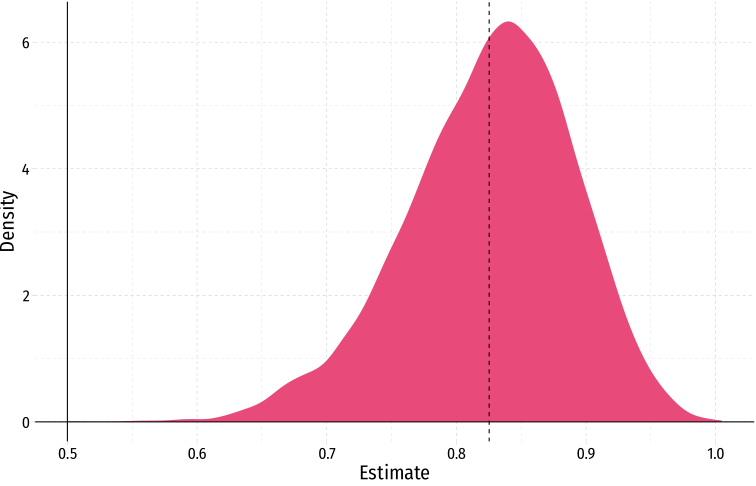
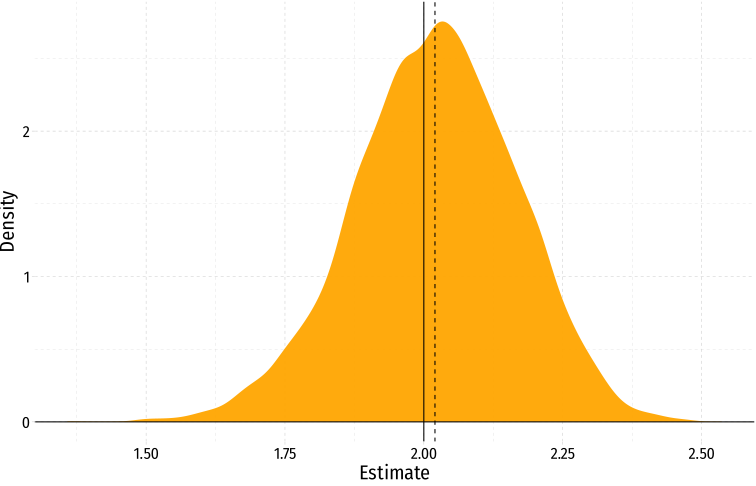
To see how this bias can look, let’s run a simulation.
\[ \begin{align} y_t = 1 + 2 x_t + 0.5 y_{t-1} + u_t \\ u_t &= 0.9 u_{t-1} + \varepsilon_t \end{align} \]
One (easy) way generate 100 disturbances from AR(1), with \(\rho = 0.9\):
We are going to run 10,000 iterations with \(T=100\).
Q: Will this simulation tell us about bias or consistency?
A: Bias. We would need to let \(T\rightarrow\infty\) to consider consistency.
Autocorrelation and bias
Simulation
Outline of our simulation:
Generate T=100 values of x
Generate T=100 values of u
- Generate T=100 values of ε
- Use ε and ρ=0.9 to calculate ut = ρ ut-1 + εt
Calculate yt = β0 + β1 xt + β2 yt-1 + ut
Regress y on x; record estimates
Repeat 1-4 10,000 times
Distribution of OLS estimates, \(\hat{\beta}_2\)
\(y_t = 1 + 2 x_t + \textcolor{#e64173}{0.5} y_{t-1} + u_t\)
Distribution of OLS estimates, \(\hat{\beta}_1\)
\(y_t = 1 + \textcolor{#FFA500}{2} x_t + 0.5 y_{t-1} + u_t\)
Testing for autocorrelation
Testing for autocorrelation
Static models
Suppose we have the static model, \[ \begin{align} \text{Births}_t = \beta_0 + \beta_1 \text{Income}_t + u_t \tag{A} \end{align} \] and we want to test for an AR(1) process in our disturbances \(u_t\).
Test for autocorrelation: Test for correlation in the lags of our residuals:
\[ \begin{align} e_t = \textcolor{#e64173}{\rho} e_{t-1} + v_t \end{align} \]
Does \(\textcolor{#e64173}{\hat{\rho}}\) differ significantly from zero?
Familiar idea: Use residuals to learn about disturbances.
Testing for autocorrelation
Static models
Specifically, to test for AR(1) disturbances in the static model \[ \begin{align} \text{Births}_t = \beta_0 + \beta_1 \text{Income}_t + u_t \tag{A} \end{align} \]
- Estimate \((\text{A})\) via OLS.
- Calculate residuals from the OLS regression in step 1.
- Regress the residuals on their lags (without an intercept).
\[ e_t = \rho e_{t-1} + v_t \]
- Use a t test to determine whether there is statistically significant evidence that \(\rho\) differs from zero.
- Rejecting H0 implies significant evidence of autocorrelation.
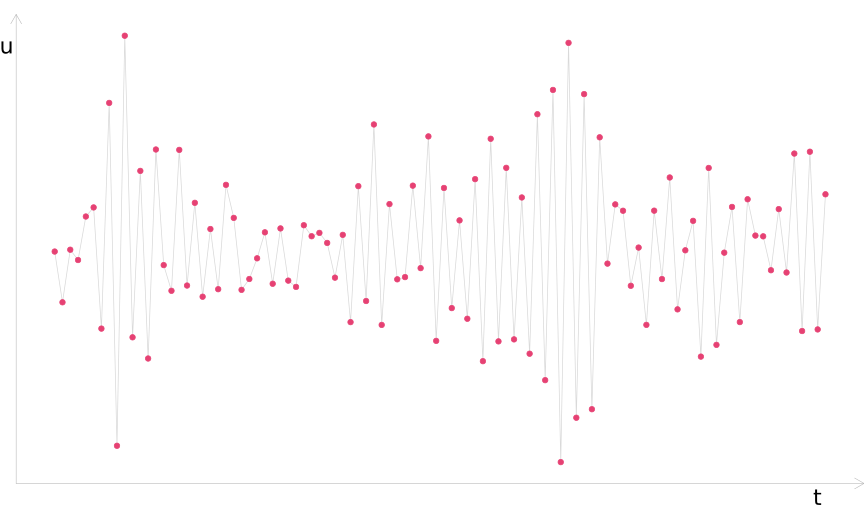
For an example, let’s return to our plot of negative autocorrelation.
Negative autocorrelation: Disturbances \(\left( u_t \right)\) over time
Testing for autocorrelation
Example: Static model and AR(1)
Step 1: Estimate the static model \(\left( y_t = \beta_0 + \beta_1 x_t + u_t \right)\) with OLS
Testing for autocorrelation
Example: Static model and AR(1)
Step 4: t test for the estimated \((\hat{\rho})\) coefficient in step 3.
# A tibble: 1 × 5
  term   estimate std.error statistic  p.value
  <chr>     <dbl>     <dbl>     <dbl>    <dbl>
1 lag(e)   -0.851    0.0535     -15.9 6.88e-29
That’s a very small p-value—much smaller than 0.05.
Reject H0 (H0 was \(\rho=0\), i.e., no autocorrelation).
Step 5: Conclude. Statistically significant evidence of autocorrelation.
Testing for autocorrelation
Example: Static model and AR(3)
What if we wanted to test for AR(3)?
We add more lags of residuals to the regression in Step 3.
We jointly test the significance of the coefficients (i.e., \(\text{LM}\) or \(F\)).
Let’s do it.
Testing for autocorrelation
Example: Static model and AR(3)
Step 1: Estimate the static model \(\left( y_t = \beta_0 + \beta_1 x_t + u_t \right)\) with OLS
Step 3: Regress the residual on its lag (no intercept)
Note: lag(v, n) from dplyr takes the nth lag of the variable v.
Testing for autocorrelation
Example: Static model and AR(3)
Step 4: Calculate the \(\text{LM} = n\times R_e^2\) test statistic—distributed \(\chi_k^2\).
\(k\) is the number of regressors in the regression in Step 3 (here, \(k=3\)).
Testing for autocorrelation
Example: Static model and AR(3)
Step 5: Conclude.
Recall: Our hypotheses consider the model \[ \begin{align} e_t = \rho_1 e_{t-1} + \rho_2 e_{t-2} + \rho_3 e_{t-3} \end{align} \]
which we are actually using to learn about the model \[ \begin{align} u_t = \rho_1 u_{t-1} + \rho_2 u_{t-2} + \rho_3 u_{t-3} \end{align} \]
H0: \(\rho_1 = \rho_2 = \rho_3 = 0\) vs. HA: \(\rho_j \neq 0\) for at least one \(j\) in \(\{1,\, 2,\, 3\}\)
Our p-value is less than 0.05.
Reject H0.
Conclude there is statistically significant evidence of autocorrelation.
Testing for autocorrelation
Dynamic models with lagged outcome variables
Recall: OLS is biased and inconsistent when our model has both
a lagged dependent variable
autocorrelated disturbances
Problem: If OLS is biased for \(\beta\), then it is also biased for \(u_t\).
∴ We can’t apply our nice trick of just using \(e_t\) to learn about \(u_t\).
Solution: Breusch-Godfrey test includes the other explanatory variables,
\[ \begin{align} e_t = \textcolor{#6A5ACD}{\underbrace{\gamma_0 + \gamma_1 x_{1t} + \gamma_2 x_{2t} + \cdots}_{\text{Explanatory variables (RHS)}}} + \textcolor{#e64173}{\underbrace{\rho_1 e_{t-1} + \rho_2 e_{t-2} + \cdots}_{\text{Lagged residuals}}} + \varepsilon_t \end{align} \]
Testing for autocorrelation
Dynamic models with lagged outcome variables
Specifically, to test for AR(2) disturbances in the ADL(1, 0) model \[ \begin{align} \text{Births}_t = \beta_0 + \beta_1 \text{Income}_t + \beta_2 \text{Births}_{t-1} + u_t \tag{B} \end{align} \]
- Estimate \((\text{B})\) via OLS.
- Calculate residuals (et) from the OLS regression in step 1.
- Regress residuals on an intercept, explanatory variables, and lagged residuals.
\[ e_t = \gamma_0 + \gamma_1 \text{Income}_t + \gamma_3 \text{Births}_{t-1} + \rho_1 e_{t-1} + \rho_2 e_{t-2} + v_t \]
- Conduct LM or F test for ρ1 = ρ2 = 0.
- Rejecting H0 implies significant evidence of AR(2).
Testing for autocorrelation
Dynamic models with lagged outcome variables
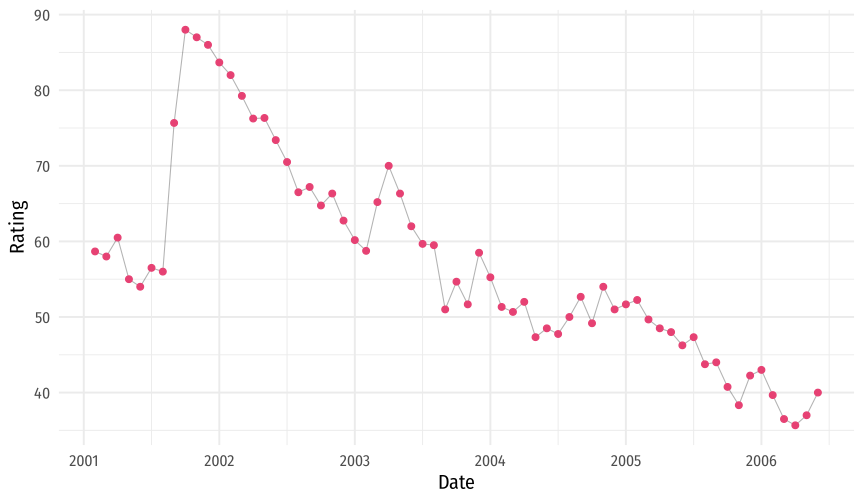
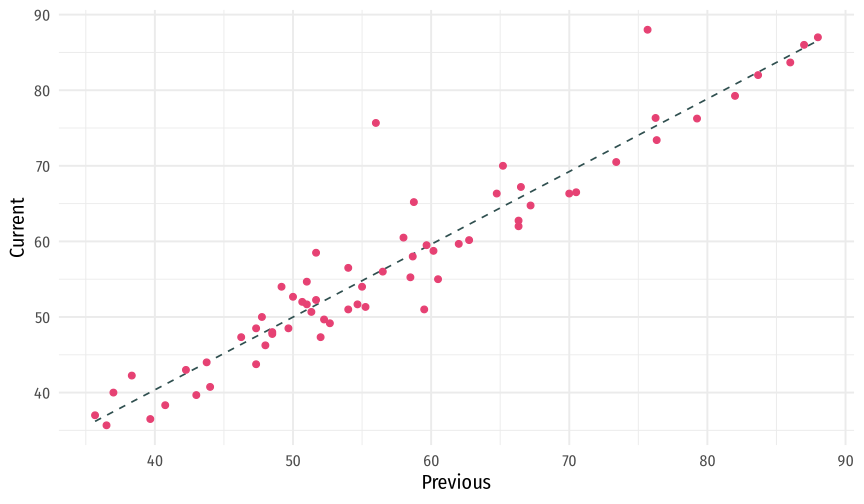
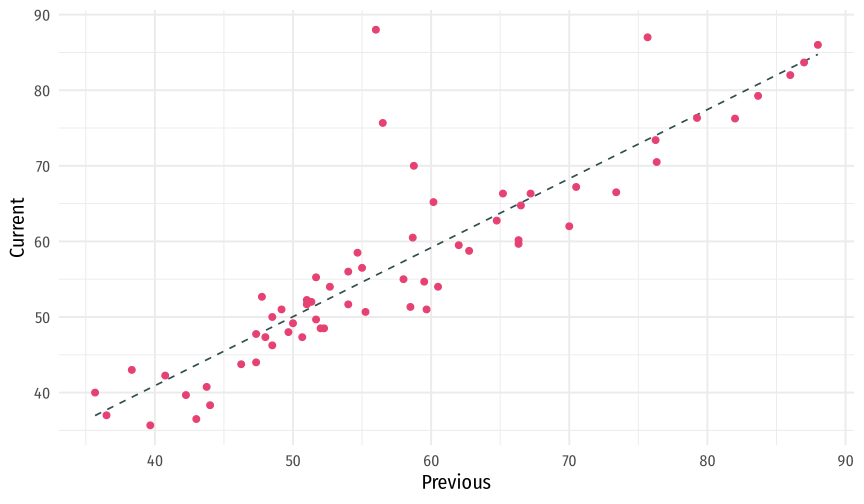
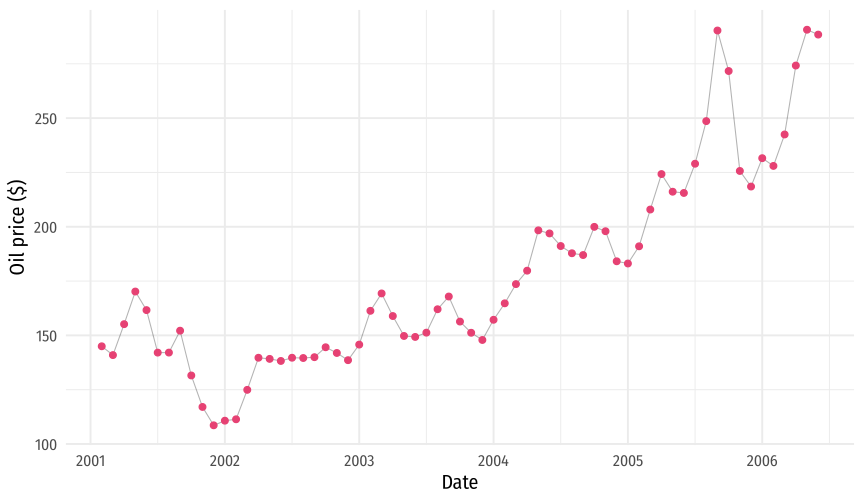
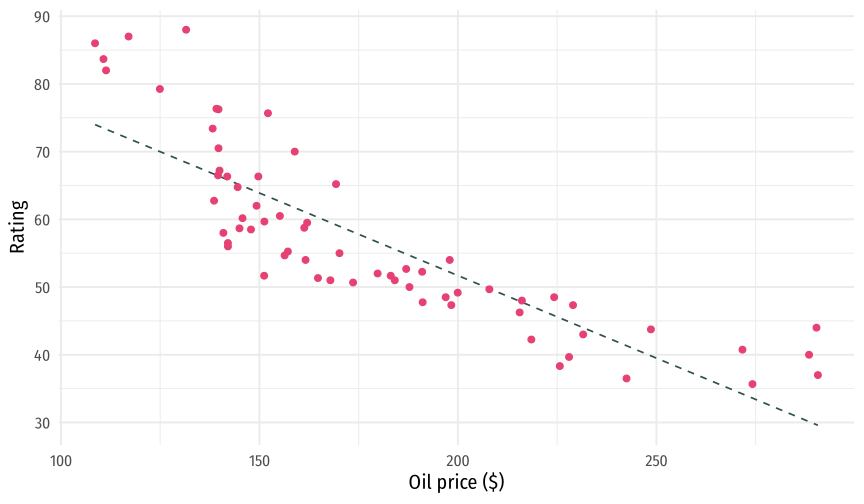
For an example, let’s consider the relationship between monthly presidential approval ratings and oil prices during President George W. Bush’s1 presidency.
We will
- specify the process as ADL(1, 0),
- test for an AR(2) process in our disturbances.
\[ \begin{align} \text{Approval}_t = \beta_0 + \beta_1 \text{Approval}_{t-1} + \beta_2 \text{Price}_t + u_t \end{align} \]
Note: We’re ignoring any other violations of exogeneity for the moment.
Monthly presidential approval ratings, 2001–2006
Approval rating vs. its one-month lag, 2001–2006
Approval rating vs. its two-month lag, 2001–2006
Oil prices, 2001–2006
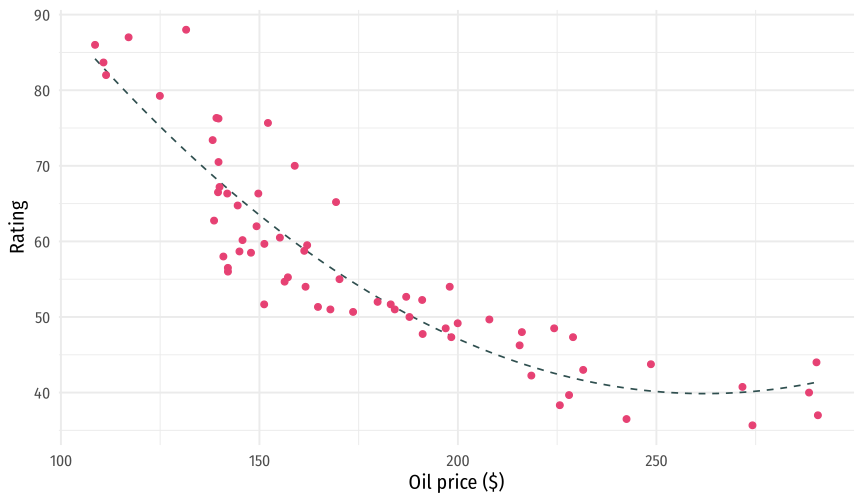
Approval rating vs. oil prices, 2001–2006
Approval rating vs. oil prices, 2001–2006 with quadratic fit
Testing for autocorrelation
Example: Approval ratings and oil prices
Step 1: Estimate our ADL(1, 0) model with OLS.
# A tibble: 3 × 5
  term         estimate std.error statistic  p.value
  <chr>           <dbl>     <dbl>     <dbl>    <dbl>
1 (Intercept)   16.2       7.86        2.06 4.40e- 2
2 lag(approve)   0.841     0.0752     11.2  2.17e-16
3 price_oil     -0.0410    0.0215     -1.90 6.15e- 2
Testing for autocorrelation
Example: Approval ratings and oil prices
Step 2: Record residuals from the OLS regression.
Note: We add an NA because we use a lag—the first element is missing.
E.g.,
{1, 2, 3, 4, 5, 6, 7, 8, 9} = x
{?, 1, 2, 3, 4, 5, 6, 7, 8} = lag(x)
{?, ?, 1, 2, 3, 4, 5, 6, 7} = lag(x, 2)
{?, ?, ?, 1, 2, 3, 4, 5, 6} = lag(x, 3)
Testing for autocorrelation
Example: Approval ratings and oil prices
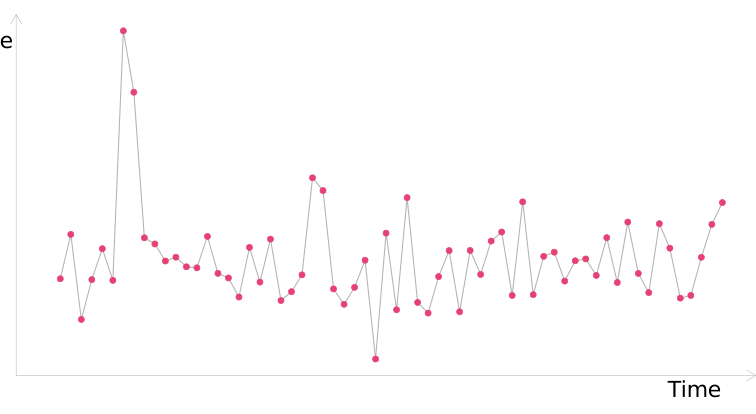
Testing for autocorrelation
Example: Approval ratings and oil prices
Step 3: Regress residuals on an intercept, the explanatory variables, and lagged residuals.
             Estimate Std. Error t value Pr(>|t|)
 (Intercept)   7.92474    9.30455   0.852   0.3979
 lag(approve) -0.08503    0.09192  -0.925   0.3589
 price_oil    -0.01690    0.02407  -0.702   0.4854
 lag(e)        0.25236    0.14648   1.723   0.0903 .
 lag(e, 2)     0.07865    0.14471   0.544   0.5889
Testing for autocorrelation
Example: Approval ratings and oil prices
Step 4: \(F\) (or \(\text{LM}\)) test for \(\rho_1=\rho_2=0\).
Recall: We can test joint significance using an \(F\) test that compares the restricted (here: \(\rho_1=\rho_2=0\)) and unrestricted models. \[ \begin{align} F_{q,\,n-p} = \dfrac{\left(\text{SSE}_r - \text{SSE}_u\right)\big/q}{\text{SSE}_u\big/\left( n-p \right)} \end{align} \] where \(q\) is the number of restrictions and \(p\) is the number of parameters in our unrestricted model (include the intercept).
We can use the waldtest() function from the lmtest package for this test.
Testing for autocorrelation
Example: Approval ratings and oil prices
Step 4: \(F\) (or \(\text{LM}\)) test for \(\rho_1=\rho_2=0\).
Here, we’re telling waldtest to test
- the model we specified in
bg_reg(our unrestricted model) - against a model without
lag(e)andlag(e, 2)(our restricted model)
Testing for autocorrelation
Example: Approval ratings and oil prices
Step 4: \(F\) (or \(\text{LM}\)) test for \(\rho_1=\rho_2=0\).
Wald test

Model 1: e ~ lag(approve) + price_oil + lag(e) + lag(e, 2)
Model 2: e ~ lag(approve) + price_oil
  Res.Df Df      F Pr(>F)
1     57
2     59 -2 1.6153 0.2078
Testing for autocorrelation
Example: Approval ratings and oil prices
Step 5: Conclusion of hypothesis test
With a p-value of \(\sim\) 0.208, we fail to reject the null hypothesis.
- We cannot reject \(\rho_1=\rho_2=0\).
- We cannot reject “no autocorrelation”.
However, we tested for a specific type of autocorrelation: AR(2).
We might get different answers with different tests.
The p-value for AR(1) is 0.0896—suggestive of first-order autocorrelation.
Living with autocorrelation
Autocorrelation
Working with it
Suppose we believe autocorrelation is present. What do we do?
I’ll give you three options.1
Misspecification
Serial-correlation robust standard errors (a.k.a. Newey-West)
FGLS
These solutions should look familiar.
Autocorrelation
Option 1: Misspecification
Misspecification with autocorrelation is very similar to our discussion with heteroskedasticity.
By incorrectly specifying your model, you can create autocorrelation.
Omitting variables that are correlated through time will cause your disturbances to be correlated through time.
Autocorrelation
Option 1: Misspecification
Example: Suppose births depend upon income and previous births \[ \begin{align} \text{Births}_t = \beta_0 + \beta_1 \text{Births}_{t-1} + \beta_2 \text{Income}_t + u_t \end{align} \]
but we write down the model as only depending upon previous births, i.e., \[ \begin{align} \text{Births}_t = \beta_0 + \beta_1 \text{Births}_{t-1} + v_t \end{align} \]
Then our disturbance \(v_t\) is \[ \begin{align} v_t = \beta_2 \text{Income}_t + u_t \end{align} \]
which is likely autocorrelated, since income is correlated in time.
Note: This autocorrelation has nothing to do with \(u_t\).
Autocorrelation
Option 1: Misspecification
“Proof”
\[ \begin{align} v_{t} &= \beta_2 \text{Income}_{t} + u_{t} \\ v_{t-1} &= \beta_2 \text{Income}_{t-1} + u_{t-1} \end{align} \]
\(\mathop{\text{Cov}} \left( v_{t},\,v_{t-1} \right)\)
\(= \mathop{\text{Cov}} \left( \beta_2 \text{Income}_{t} + u_{t},\, \beta_2 \text{Income}_{t-1} + u_{t-1} \right)\)
\(= \textcolor{#e64173}{\mathop{\text{Cov}} \left( \beta_2 \text{Income}_{t},\, \beta_2 \text{Income}_{t-1} \right)} + \mathop{\text{Cov}} \left( \beta_2 \text{Income}_{t},\, u_t \right)\)
\(\textcolor{#ffffff}{=} + \mathop{\text{Cov}} \left(u_{t},\, \beta_2 \text{Income}_{t-1}\right) + \mathop{\text{Cov}} \left( u_{t},\, u_{t-1} \right)\)
\(\neq 0\) (in general) even if \(u_t\) is exogenous and without autocorrelation.
Autocorrelation
Option 2: Newey-West standard errors
We can just focus on estimating consistent standard errors (fixing inference) in the presence of autocorrelation.
As we did with the heteroskedasticity-robust standard errors.
These standard errors are called serial-correlation robust standard errors (or Newey-West standard errors).1
                           est_iid             est_nw
Dependent Var.:            approve            approve

Constant            16.16* (7.860)    16.16** (5.863)
l(approve)      0.8405*** (0.0752) 0.8405*** (0.0497)
price_oil        -0.0410. (0.0215)  -0.0410* (0.0176)
_______________ __________________ __________________
S.E. type                      IID   Newey-West (L=2)
Observations                    64                 64
R2                         0.90722            0.90722
Adj. R2                    0.90417            0.90417
---
Signif. codes: 0 '***' 0.001 '**' 0.01 '*' 0.05 '.' 0.1 ' ' 1
The p-values on the price of oil coefficient: 0.062 vs. 0.023.
Autocorrelation
Option 3: FGLS
If we do not have a lagged outcome variable, then feasible generalized least squares (FGLS) can give us efficient and consistent standard errors.
Let’s start with a simple static model that includes an AR(1) disturbance \(u_t\).
\[ \begin{align} \text{Births}_t &= \beta_0 + \beta_1 \text{Income}_t + u_t \tag{1} \\ u_t &= \rho u_{t-1} + \varepsilon_t \tag{2} \end{align} \]
Now our old trick: Write out \((1)\) for period \(t-1\) (and then multiple by \(\rho\)) \[ \begin{align} \text{Births}_{t-1} &= \beta_0 + \beta_1 \text{Income}_{t-1} + u_{t-1} \tag{3} \\ \rho \text{Births}_{t-1} &= \rho \beta_0 + \rho \beta_1 \text{Income}_{t-1} + \rho u_{t-1} \tag{4} \end{align} \]
And now subtract \((4)\) from \((1)\)…
Autocorrelation
Option 3: FGLS
\[ \begin{align} \text{Births}_t - \rho \text{Births}_{t-1} =& \beta_0 \left( 1 - \rho \right) + \\ & \beta_1 \text{Income}_t - \rho \beta_1 \text{Income}_{t-1} + \\ & u_t - \rho u_{t-1} \end{align} \]
which gives us a very specific dynamic model \[ \begin{align} \text{Births}_t =& \beta_0 \left( 1 - \rho \right) + \rho \text{Births}_{t-1} +\\ & \beta_1 \text{Income}_t - \rho \beta_1 \text{Income}_{t-1} + \\ & \textcolor{#e64173}{\underbrace{u_t - \rho u_{t-1}}_{=\varepsilon_t}} \\ \textcolor{#ffffff}{=}& \textcolor{#ffffff}{\beta_0 \left( 1 - \rho \right) + \rho \text{Births}_{t-1} +}\\ &\textcolor{#ffffff}{ \beta_1 \text{Income}_t - \rho \beta_1 \text{Income}_{t-1} + \varepsilon_t} \end{align} \]
Autocorrelation
Option 3: FGLS
\[ \begin{align} \text{Births}_t - \rho \text{Births}_{t-1} =& \beta_0 \left( 1 - \rho \right) + \\ & \beta_1 \text{Income}_t - \rho \beta_1 \text{Income}_{t-1} + \\ & u_t - \rho u_{t-1} \end{align} \] which gives us a very specific dynamic model \[ \begin{align} \text{Births}_t =& \beta_0 \left( 1 - \rho \right) + \rho \text{Births}_{t-1} +\\ & \beta_1 \text{Income}_t - \rho \beta_1 \text{Income}_{t-1} + \\ & \textcolor{#e64173}{\underbrace{u_t - \rho u_{t-1}}_{=\varepsilon_t}} \\ =& \beta_0 \left( 1 - \rho \right) + \rho \text{Births}_{t-1} +\\ & \beta_1 \text{Income}_t - \rho \beta_1 \text{Income}_{t-1} + \textcolor{#e64173}{\varepsilon_t} \end{align} \] that happens to be free of autocorrelation.
Autocorrelation
Option 3: FGLS
This transformed model is free of autocorrelation. \[ \begin{align} \text{Births}_t =& \beta_0 \left( 1 - \rho \right) + \rho \text{Births}_{t-1} +\\ & \beta_1 \text{Income}_t - \rho \beta_1 \text{Income}_{t-1} + \textcolor{#e64173}{\varepsilon_t} \end{align} \]
Q: How do we actually estimate this model? (We don’t know \(\rho\).)
A: FGLS (of course)…
- Estimate the original (untransformed) model; save residuals.
- Estimate \(\rho\): Regress residuals on their lags (no intercept).
- Estimate the transformed model, plugging in \(\hat{\rho}\) for \(\rho\).
Autocorrelation
Summary: Main ideas
Autocorrelation means the disturbances correlated through time, \[\mathop{\text{Cov}}\left(u_t, u_s\right) \neq 0 \quad \text{for } t \neq s.\]
For static time-series models, OLS coefficient estimates are unbiased1,
but OLS standard errors are biased and OLS is inefficient.For lagged outcome variables, OLS coefficient estimates
are biased and inconsistent.
Once again, violating assumptions can lead to bad decisions.
Autocorrelation
Summary: Testing/living with autocorrelation
Tests for autocorrelation involve regressing residuals on their lags.
In static models: regress residuals on their lags.
In dynamic models with lagged outcomes: use Breusch-Godfrey
regress residuals on the original regressors plus lagged residuals.
Potential solutions/responses (akin to heteroskedasticity):
Consider whether the model is misspecified.
Use Newey-West standard errors.
For static models with AR disturbances, FGLS can transform the model to remove autocorrelation.