Main references for today
- Miranda & Fackler (2002), Ch. 4
- Judd (1998), Ch. 4
- Nocedal & Writght (2006), Chs. 12, 15, 17–19
- JuMP documentation
Constrained optimization: modeling framework
University of Illinois Urbana-Champaign
We are going to cover a cool package called JuMP.jl

Most solvers can be accessed directly in their own packages
Optim.jlBut JuMP gives us a unified way of specifying our models and switching between solvers
JuMP is specifically designed for constrained optimization but works with unconstrained too
Optim or NLopt directlyJuMP also solves MCPs in a much more user-friendly way than working directly with NLSolve.jl
There are 5 key steps:
mymodel = Model(SomeOptimizer)@variable(mymodel, x >= 0)@objective(mymodel, Min, 12x^0.7 + 20y^2)@constraint(mymodel, c1, 6x^2 - 2y >= 100)optimize!(mymodel)!, so we are modifying mymodel and saving results in this objectLet’s use JuMP to solve the illustrative problem from the first slides
We will use solver Ipopt, which stands for Interior Point Optimizer. It’s a free solver we can access through package Ipopt.jl
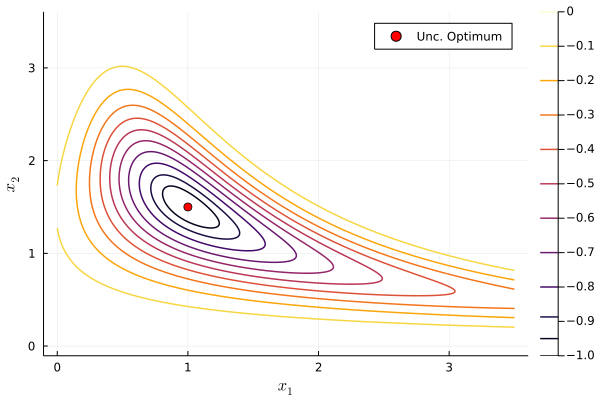
Define the function: \[ \min_x -exp\left(-(x_1 x_2 - 1.5)^2 - (x_2 - 1.5)^2 \right) \]
Initialize the model for Ipopt
A JuMP Model
├ solver: Ipopt
├ objective_sense: FEASIBILITY_SENSE
├ num_variables: 0
├ num_constraints: 0
└ Names registered in the model: none
You can set optimzer parameters like this (there are TONS of parameters you can adjust (see the manual)
We will focus on non-negative values
@variable(my_model, x_1) to declare a \(x_1\) as a free variablestart argument like this@variable(my_first_model, x_1 >=0, start = 0)$ ({({{({{(x_1x_2 - 1.5)} ^ {2}})} - {(x_2^2 - 3 x_2 + 2.25)}})}) $
JuMP will use autodiff (with ForwardDiff package) by default. If you want to use your define gradient and Hessian, you need to “register” the function like this
register(my_first_model, :my_f, n, f, grad, hessian):my_f is the name you want to use inside model, n is the number of variables f takes, and grad hessian are user-defined functionsFirst, let’s solve the (mostly) unconstrained problem
x_1 and x_2Checking our model
******************************************************************************
This program contains Ipopt, a library for large-scale nonlinear optimization.
 Ipopt is released as open source code under the Eclipse Public License (EPL).
         For more information visit https://github.com/coin-or/Ipopt
******************************************************************************

This is Ipopt version 3.14.19, running with linear solver MUMPS 5.8.2.

Number of nonzeros in equality constraint Jacobian...:        0
Number of nonzeros in inequality constraint Jacobian.:        0
Number of nonzeros in Lagrangian Hessian.............:        3

Total number of variables............................:        2
                     variables with only lower bounds:        2
                variables with lower and upper bounds:        0
                     variables with only upper bounds:        0
Total number of equality constraints.................:        0
Total number of inequality constraints...............:        0
        inequality constraints with only lower bounds:        0
   inequality constraints with lower and upper bounds:        0
        inequality constraints with only upper bounds:        0

iter    objective    inf_pr   inf_du lg(mu)  ||d||  lg(rg) alpha_du alpha_pr  ls
   0 -1.1449605e-02 0.00e+00 1.03e+00  -1.0 0.00e+00    -  0.00e+00 0.00e+00   0
   1 -1.5851349e-02 0.00e+00 5.92e-02  -1.0 1.00e-01    -  9.46e-01 1.00e+00f  1
   2 -2.0400403e-02 0.00e+00 8.01e-02  -2.5 7.88e-02   0.0 1.00e+00 1.00e+00f  1
   3 -5.7955817e-02 0.00e+00 1.59e-01  -2.5 3.13e-01  -0.5 5.40e-01 1.00e+00f  1
   4 -3.2486363e-01 0.00e+00 6.94e-01  -2.5 4.79e-01  -0.1 9.28e-01 1.00e+00f  1
   5 -9.8805653e-01 0.00e+00 3.06e-01  -2.5 1.76e+00   0.4 4.46e-01 2.50e-01f  3
   6 -9.9994167e-01 0.00e+00 1.94e-02  -2.5 7.65e-02    -  1.00e+00 1.00e+00f  1
   7 -1.0000000e+00 0.00e+00 6.69e-05  -3.8 6.16e-03    -  1.00e+00 1.00e+00f  1
   8 -1.0000000e+00 0.00e+00 1.83e-09  -5.7 4.81e-05    -  1.00e+00 1.00e+00f  1
   9 -1.0000000e+00 0.00e+00 4.78e-13  -8.6 4.09e-07    -  1.00e+00 1.00e+00f  1
iter    objective    inf_pr   inf_du lg(mu)  ||d||  lg(rg) alpha_du alpha_pr  ls
  10 -1.0000000e+00 0.00e+00 1.81e-15 -10.0 5.37e-10    -  1.00e+00 1.00e+00f  1

Number of Iterations....: 10

                                   (scaled)                 (unscaled)
Objective...............:  -9.9999999999999956e-01   -9.9999999999999956e-01
Dual infeasibility......:   1.8095926524754548e-15    1.8095926524754548e-15
Constraint violation....:   0.0000000000000000e+00    0.0000000000000000e+00
Variable bound violation:   0.0000000000000000e+00    0.0000000000000000e+00
Complementarity.........:   9.0909092205936933e-11    9.0909092205936933e-11
Overall NLP error.......:   9.0909092205936933e-11    9.0909092205936933e-11


Number of objective function evaluations             = 17
Number of objective gradient evaluations             = 11
Number of equality constraint evaluations            = 0
Number of inequality constraint evaluations          = 0
Number of equality constraint Jacobian evaluations   = 0
Number of inequality constraint Jacobian evaluations = 0
Number of Lagrangian Hessian evaluations             = 10
Total seconds in IPOPT                               = 3.717

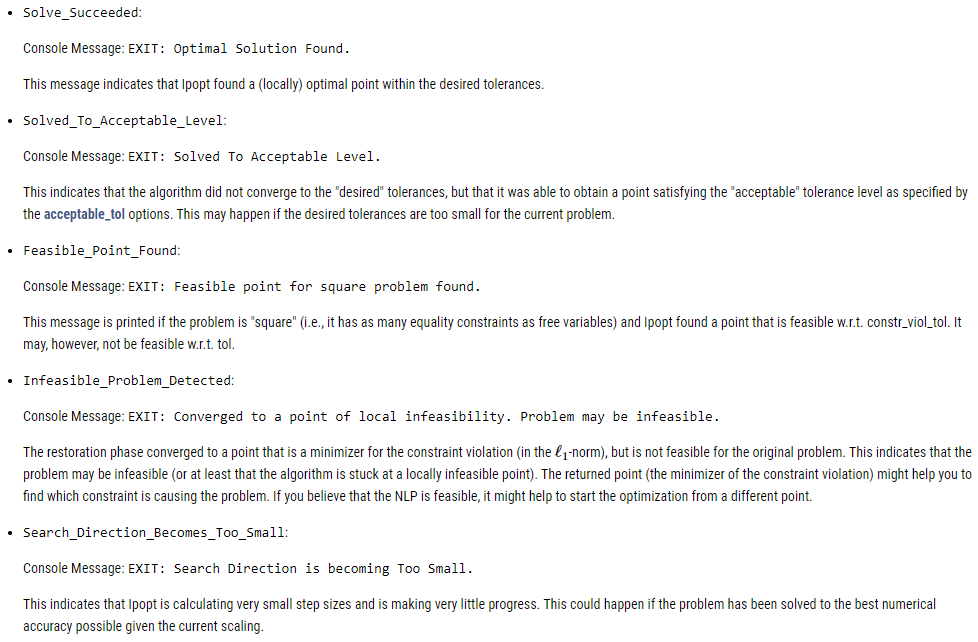
EXIT: Optimal Solution Found.The return message is rather long and contains many details about the execution. You can turn this message off with
We can check minimizers with
And the minimum with
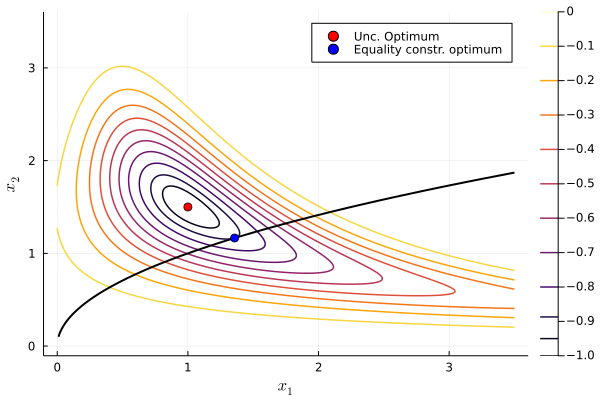
Let’s create a new model that now adds a nonlinear equality constraint \(x_1 = x_2^2\)
start. If we don’t do it, the solution will converge to another local minimum that is incorrect.\[ \begin{aligned} \min\quad & \textsf{-}\left({\textsf{exp}\left({{\textsf{-}\left({{\left(x\_1\times x\_2 - 1.5\right)} ^ {2}}\right)} - {\left(x\_2^2 - 3 x\_2 + 2.25\right)}}\right)}\right)\\ \text{Subject to} \quad & x\_2^2 - x\_1 = 0\\ & x\_1 \geq 0\\ & x\_2 \geq 0\\ \end{aligned} \]
Now let’s solve it
This is Ipopt version 3.14.19, running with linear solver MUMPS 5.8.2.

Number of nonzeros in equality constraint Jacobian...:        2
Number of nonzeros in inequality constraint Jacobian.:        0
Number of nonzeros in Lagrangian Hessian.............:        4

Total number of variables............................:        2
                     variables with only lower bounds:        2
                variables with lower and upper bounds:        0
                     variables with only upper bounds:        0
Total number of equality constraints.................:        1
Total number of inequality constraints...............:        0
        inequality constraints with only lower bounds:        0
   inequality constraints with lower and upper bounds:        0
        inequality constraints with only upper bounds:        0

iter    objective    inf_pr   inf_du lg(mu)  ||d||  lg(rg) alpha_du alpha_pr  ls
   0 -6.0653066e-01 0.00e+00 2.17e+00  -1.0 0.00e+00    -  0.00e+00 0.00e+00   0
   1 -8.6248277e-01 4.95e-02 1.17e+00  -1.0 8.90e-01    -  5.53e-01 5.00e-01f  2
   2 -8.8715068e-01 2.30e-03 3.89e-02  -1.0 6.78e-02    -  1.00e+00 1.00e+00h  1
   3 -8.8798525e-01 7.75e-05 1.92e-03  -2.5 1.84e-02    -  1.00e+00 1.00e+00h  1
   4 -8.8797477e-01 1.72e-07 4.56e-06  -3.8 8.88e-04    -  1.00e+00 1.00e+00h  1
   5 -8.8797474e-01 1.52e-10 4.25e-09  -5.7 2.85e-05    -  1.00e+00 1.00e+00h  1
   6 -8.8797474e-01 2.15e-14 5.91e-13  -8.6 3.44e-07    -  1.00e+00 1.00e+00h  1

Number of Iterations....: 6

                                   (scaled)                 (unscaled)
Objective...............:  -8.8797474226644846e-01   -8.8797474226644846e-01
Dual infeasibility......:   5.9061837706105664e-13    5.9061837706105664e-13
Constraint violation....:   2.1538326677728037e-14    2.1538326677728037e-14
Variable bound violation:   0.0000000000000000e+00    0.0000000000000000e+00
Complementarity.........:   2.5063705829534306e-09    2.5063705829534306e-09
Overall NLP error.......:   2.5063705829534306e-09    2.5063705829534306e-09


Number of objective function evaluations             = 12
Number of objective gradient evaluations             = 7
Number of equality constraint evaluations            = 12
Number of inequality constraint evaluations          = 0
Number of equality constraint Jacobian evaluations   = 7
Number of inequality constraint Jacobian evaluations = 0
Number of Lagrangian Hessian evaluations             = 6
Total seconds in IPOPT                               = 0.048

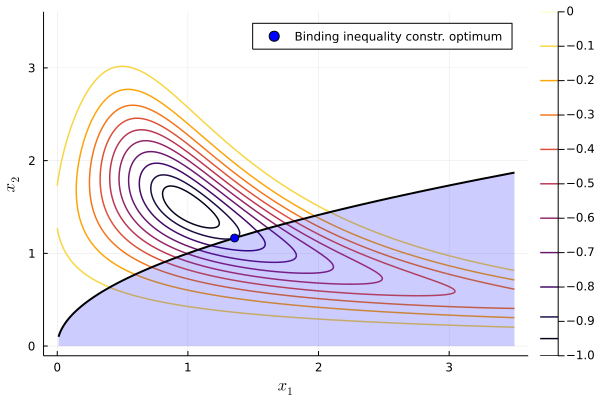
EXIT: Optimal Solution Found.Next, let’s now initialize a new model with inequality constraint \(-x_1 + x^2 \leq 0\)
This is Ipopt version 3.14.19, running with linear solver MUMPS 5.8.2.

Number of nonzeros in equality constraint Jacobian...:        0
Number of nonzeros in inequality constraint Jacobian.:        2
Number of nonzeros in Lagrangian Hessian.............:        4

Total number of variables............................:        2
                     variables with only lower bounds:        2
                variables with lower and upper bounds:        0
                     variables with only upper bounds:        0
Total number of equality constraints.................:        0
Total number of inequality constraints...............:        1
        inequality constraints with only lower bounds:        0
   inequality constraints with lower and upper bounds:        0
        inequality constraints with only upper bounds:        1

iter    objective    inf_pr   inf_du lg(mu)  ||d||  lg(rg) alpha_du alpha_pr  ls
   0 -1.1449605e-02 0.00e+00 1.03e+00  -1.0 0.00e+00    -  0.00e+00 0.00e+00   0
   1 -1.5854730e-02 0.00e+00 1.19e-01  -1.0 1.01e-01    -  8.94e-01 1.00e+00f  1
   2 -2.3961281e-02 0.00e+00 9.81e-02  -2.5 1.23e-01    -  5.75e-01 1.00e+00h  1
   3 -3.5003934e-02 0.00e+00 1.02e-01  -2.5 1.08e-01   0.0 1.00e+00 1.00e+00h  1
   4 -9.4823477e-01 9.72e-01 5.53e-01  -2.5 2.08e+00  -0.5 1.55e-01 5.00e-01f  2
   5 -9.6090312e-01 8.92e-01 4.52e-01  -2.5 6.55e-01    -  1.00e+00 1.83e-01h  1
   6 -8.8648990e-01 2.74e-02 2.41e-01  -2.5 3.17e-01    -  1.00e+00 1.00e+00h  1
   7 -8.8504642e-01 0.00e+00 1.42e-02  -2.5 6.45e-02    -  1.00e+00 1.00e+00h  1
   8 -8.8775756e-01 0.00e+00 1.15e-04  -3.8 1.59e-02    -  1.00e+00 1.00e+00h  1
   9 -8.8797273e-01 0.00e+00 4.64e-07  -5.7 1.28e-03    -  1.00e+00 1.00e+00h  1
iter    objective    inf_pr   inf_du lg(mu)  ||d||  lg(rg) alpha_du alpha_pr  ls
  10 -8.8797474e-01 0.00e+00 4.40e-11  -8.6 1.19e-05    -  1.00e+00 1.00e+00h  1

Number of Iterations....: 10

                                   (scaled)                 (unscaled)
Objective...............:  -8.8797474144904420e-01   -8.8797474144904420e-01
Dual infeasibility......:   4.4034561945229721e-11    4.4034561945229721e-11
Constraint violation....:   0.0000000000000000e+00    0.0000000000000000e+00
Variable bound violation:   0.0000000000000000e+00    0.0000000000000000e+00
Complementarity.........:   2.5196089194342299e-09    2.5196089194342299e-09
Overall NLP error.......:   2.5196089194342299e-09    2.5196089194342299e-09


Number of objective function evaluations             = 14
Number of objective gradient evaluations             = 11
Number of equality constraint evaluations            = 0
Number of inequality constraint evaluations          = 14
Number of equality constraint Jacobian evaluations   = 0
Number of inequality constraint Jacobian evaluations = 11
Number of Lagrangian Hessian evaluations             = 10
Total seconds in IPOPT                               = 0.002

EXIT: Optimal Solution Found.Same results as in the equality constraint: the constraint is binding
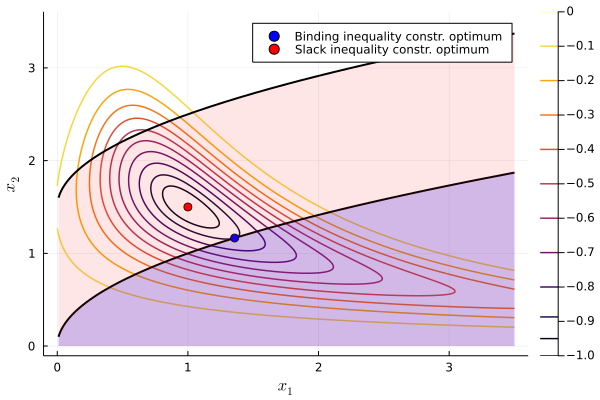
What if instead we use inequality constraint \(-x_1 + x^2 \leq 1.5\)?
This is Ipopt version 3.14.19, running with linear solver MUMPS 5.8.2.

Number of nonzeros in equality constraint Jacobian...:        0
Number of nonzeros in inequality constraint Jacobian.:        2
Number of nonzeros in Lagrangian Hessian.............:        4

Total number of variables............................:        2
                     variables with only lower bounds:        2
                variables with lower and upper bounds:        0
                     variables with only upper bounds:        0
Total number of equality constraints.................:        0
Total number of inequality constraints...............:        1
        inequality constraints with only lower bounds:        0
   inequality constraints with lower and upper bounds:        0
        inequality constraints with only upper bounds:        1

iter    objective    inf_pr   inf_du lg(mu)  ||d||  lg(rg) alpha_du alpha_pr  ls
   0 -1.1449605e-02 0.00e+00 1.03e+00  -1.0 0.00e+00    -  0.00e+00 0.00e+00   0
   1 -1.5850397e-02 0.00e+00 5.90e-02  -1.0 1.00e-01    -  9.48e-01 1.00e+00f  1
   2 -2.0385980e-02 0.00e+00 7.93e-02  -2.5 7.82e-02   0.0 1.00e+00 1.00e+00h  1
   3 -5.7025390e-02 0.00e+00 1.59e-01  -2.5 3.10e-01  -0.5 5.44e-01 1.00e+00h  1
   4 -2.5193623e-01 0.00e+00 5.01e-01  -2.5 3.49e-01  -0.1 7.98e-01 1.00e+00h  1
   5 -8.9618378e-01 0.00e+00 1.57e+00  -2.5 7.27e-01   0.4 1.00e+00 1.00e+00f  1
   6 -9.6541187e-01 1.22e-01 6.65e-01  -2.5 1.84e+00    -  1.00e+00 7.20e-01h  1
   7 -9.9523888e-01 0.00e+00 8.42e-02  -2.5 5.13e-01    -  1.00e+00 1.00e+00f  1
   8 -9.9837590e-01 0.00e+00 3.44e-03  -2.5 1.16e-01    -  1.00e+00 1.00e+00h  1
   9 -9.9987546e-01 0.00e+00 2.44e-03  -3.8 1.08e-01    -  1.00e+00 1.00e+00h  1
iter    objective    inf_pr   inf_du lg(mu)  ||d||  lg(rg) alpha_du alpha_pr  ls
  10 -9.9999483e-01 0.00e+00 1.88e-04  -3.8 3.37e-02    -  1.00e+00 1.00e+00h  1
  11 -9.9999999e-01 0.00e+00 1.26e-05  -5.7 8.23e-03    -  1.00e+00 1.00e+00h  1
  12 -1.0000000e+00 0.00e+00 1.83e-08  -8.6 3.23e-04    -  1.00e+00 1.00e+00h  1
  13 -1.0000000e+00 0.00e+00 4.65e-14  -9.0 4.66e-07    -  1.00e+00 1.00e+00h  1

Number of Iterations....: 13

                                   (scaled)                 (unscaled)
Objective...............:  -1.0000000000000000e+00   -1.0000000000000000e+00
Dual infeasibility......:   4.6486804967210195e-14    4.6486804967210195e-14
Constraint violation....:   0.0000000000000000e+00    0.0000000000000000e+00
Variable bound violation:   0.0000000000000000e+00    0.0000000000000000e+00
Complementarity.........:   9.0912126294342428e-10    9.0912126294342428e-10
Overall NLP error.......:   9.0912126294342428e-10    9.0912126294342428e-10


Number of objective function evaluations             = 14
Number of objective gradient evaluations             = 14
Number of equality constraint evaluations            = 0
Number of inequality constraint evaluations          = 14
Number of equality constraint Jacobian evaluations   = 0
Number of inequality constraint Jacobian evaluations = 14
Number of Lagrangian Hessian evaluations             = 13
Total seconds in IPOPT                               = 0.002

EXIT: Optimal Solution Found.We get the same results as in the unconstrained case
Plug in your guess, let the solver go, and you’re done right?
WRONG!
These algorithms are not guaranteed to always find even a local solution, you need to test and make sure you are converging correctly
Return codes (or exit flags) tell you why the solver stopped
JuMP you can use @show termination_status(mymodel)READ THE SOLVER DOCUMENTATION!
Use trace options to get a sense of what went wrong
Examples from Ipopt.jl documentation
Optimization is approximately 53% art
Not all algorithms are suited for every problem \(\rightarrow\) it is useful to check how different algorithms perform
Interior-point is usually the default in constrained optimization solvers (low memory usage, fast), but try other algorithms and see if the solution generally remains the same
The scaling of a problem matters for optimization performance
A problem is poorly scaled if changes to \(x\) in a certain direction produce much bigger changes in \(f\) than changes to in \(x\) in another direction
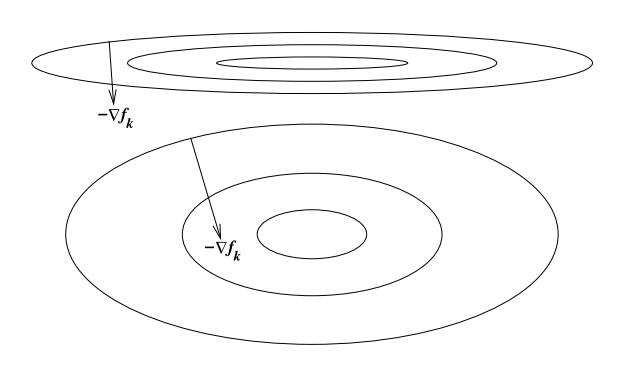
Ex: \(f(x) = 10^9 x_1^2 + x_2^2\) is poorly scaled
This happens when things change at different rates:
How do we solve this issue?
Rescale the problem: put them in units that are generally within an order of magnitude of 1
Two main tolerances in optimization:
ftol is the tolerance for the change in the function value (absolute and relative)xtol is the tolerance for the change in the input values (absolute and relative)What is a suitable tolerance?
It depends
Explore sensitivity to tolerance, typically pick a conservative (small) number
1e-6If you are using simulation-based estimators or estimators that depend on successive optimizations, be even more conservative because errors compound
May be a substantial trade-off between accuracy of your solution and speed
Common bad practice is to pick a larger tolerance (e.g. 1e-3) so the problem “works” (e.g. so your big MLE converges)
Issue is that 1e-3 might be pretty big for your problem if you haven’t checked that your solution is not sensitive to the tolerance
Initial guesses matter
Good ones can improve performance
Bad ones can give you terrible performance, or wrong answers if your problem isn’t perfect