ACE 592 - Lecture 1.3
An introduction to programming with Julia
University of Illinois Urbana-Champaign
Course Roadmap
- Introduction to Scientific Computing
- Motivation
- Best practices
- Intro to programming
- Fundamentals of numerical methods
- Systems of equations
- Optimization
- Function approximation
- Structural estimation
Agenda
- Today we start a crash course on programming using Julia
- We will cover the main features to get you started…
- Of course, we’ll be just scratching the surface. You’ll learn a lot more as we go
- Unless you told me you are using a different language, by now you hopefully have installed
- Julia
- Visual Studio Code with Julia extension
Relevant sources for this lecture
- Software Carpentry
- QuantEcon
- Lecture notes for Grant McDermott’s Data Science for Economists (Oregon) and Ivan Rudik’s Dynamic Optimization (Cornell)
- Julia documentation
Why learn Julia?
Reason 1: It is easy to learn and use
Julia is a high-level language
- Low-level = you write instructions are closer to what the hardware understands (Assembly, C++, Fortran)
- These are usually the fastest because there is little to translate (what a compiler does) and you can optimize your code depending on your hardware
- High-level means you write in closer to human language (Julia, R, Python)
- The compiler has to do a lot more work to translate your instructions
Why learn Julia?
Reason 2: Julia delivers C++ and Fortran speed
Sounds like magic, but it’s just a clever combination of design choices targeting numerical methods
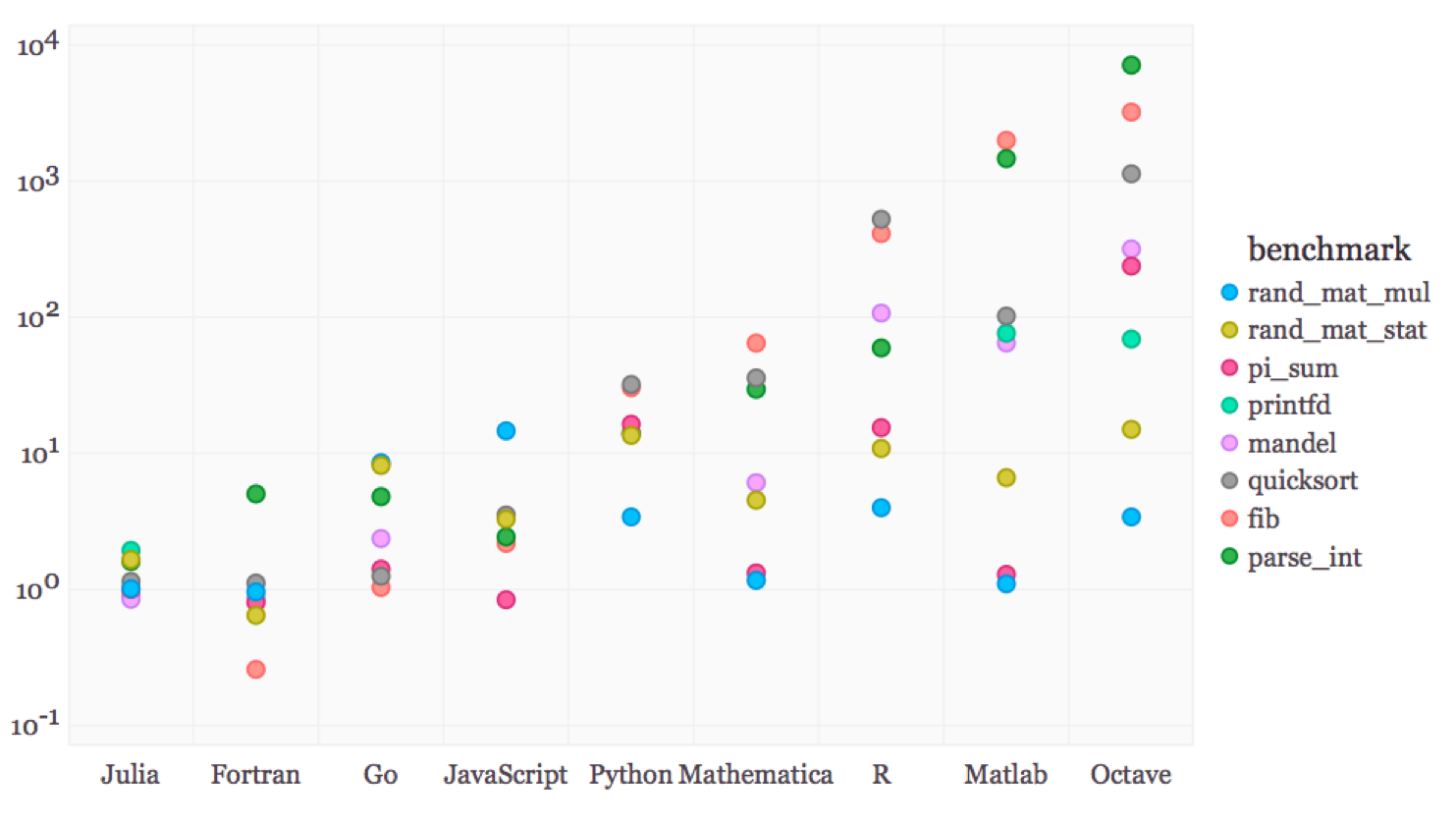
In this graph, time to execute in C++ is 1
Why learn Julia?
Reason 3: Julia is free, open-source, and popular
- You don’t need expensive licenses to use (unlike Matlab)
- The people who want to use or verify what you did also don’t have to pay
- There is a large and active community of users and developers
- So it’s easy to get help and new packages
Tools for programming in Julia
There are 2 Integrated Development Environments (IDEs) I generally recommend
- Visual Studio (VS) code
- Jupyter Lab notebooks
In this course, we will only program plain .jl files, so I highly recommend you get familiarized with VS code
- At the end of this unit, we will talk about using AI tools to help you learn to code and become a more productive programmer
Intro to programming
Programming \(\equiv\) writing a set of instructions
- There are hard rules you can’t break if you want your code to work
- There are elements of style (e.g. Strunk and White) that make your code easier to read, modify, and maintain
- There are elements that make your code more efficient
- Using less time or space (memory)
Intro to programming
If you will be doing computational work, there are:
- Language-independent coding basics you should know
- Arrays are stored in memory in particular ways
- Language-independent best practices you should use
- Indent to convey program structure, naming conventions
- Language-dependent idiosyncracies that matter for function, speed, etc
- Vectorizing, memory management
Intro to programming
Learning these early will:
- Make coding a lot easier
- Reduce total programmer time
- Reduce total computer time
- Make your code understandable by someone else or your future self
- Make your code flexible
A broad view of programming
Your goal is to make a program
A program is made of different components and sub-components
The most basic component is a statement, more commonly called a line of code
A broad view of programming
Here is an example of a pseudoprogram:
This program is very simple:
- Create a deck of cards
A broad view of programming
Here is an example of a pseudoprogram:
This program is very simple:
Create a deck of cards
Shuffle the deck
A broad view of programming
Here is an example of a pseudoprogram:
This program is very simple:
Create a deck of cards
Shuffle the deck
Draw the top card
A broad view of programming
Here is an example of a pseudoprogram:
This program is very simple:
Create a deck of cards
Shuffle the deck
Draw the top card
Print it
A broad view of programming
What are the parentheses and why are they different from square brackets?
How does shuffle work?
What’s println?
It’s important to know that a good program has understandable code
Julia specifics
We will discuss coding in the context of Julia but a lot of this ports to Python, MATLAB, etc1
We will review
- Types
- Functions
- Iterating
- Broadcasting/vectorization
And some slightly more advanced aspects to help you debug
- Scope
- Multiple dispatch
1. Types
Types: boolean
All languages have some kind of variable types like integers or arrays
Types: boolean
We can save the boolean value of actual statements in variables this way:
@showis a Julia macro for showing the operation.- You can think of a macro as a shortcut name that calls a bunch of other things to run
Quick detour: logical operators
Logical operators work like you’d think
== (equal equal) tests for equality
Quick detour: logical operators
You can also test for approximate equality with \(\approx\) (type \approx<TAB>)
- We will see why this can be super useful in the next unit
Now back to types
Types: numbers
Two other data types you will use frequently are integers
Types: numbers
You can always instantiate alternative floating point number types
Types: numbers
Math works like you would expect:
Types: numbers
In Julia, you dont need * in between numeric literals (numbers) and variables
- But I advise you use the explicit notation anyway to avoid bugs
Types: strings
Strings store sequences of characters
You implement them with double quotations:
- Note that
;is used to suppress output for that line of code - Unlike some other languages, in Julia you don’t need to add
;after every command
Types: strings
It’s easy to work with strings. Use $ to interpolate a variable/expression
You probably won’t use strings too often unless you’re working with text data or printing output.
- Note that
;can also be used to type multiple commands in the same line. I’m doing it make all fit in one slide, but you should avoid it
Types: containers
Containers are types that store collections of data
The most basic container is the Array which is denoted by square brackets
Arrays are mutable, which means you can change their values
Types: containers
An alternative to the Array is the Tuple, which is denoted by parentheses
Types: containers
Tuples are immutable which means you can’t change their values
Types: containers
Tuples don’t need parentheses (but it’s probably best practice for clarity)
Types: containers
Tuples can be unpacked
This is basically how functions return multiple outputs when you call them!
Types: containers
But an alternative and more efficient container is the NamedTuple
Another way of accessing x and y inside the NamedTuple is
Types: containers
A Dictionary is the last main container type
- They are like arrays but are indexed by keys (names) instead of numbers
d1 is a dictionary where the key are strings and the values are any kind of type
Types: containers
Reference specific values you want in the dictionary by referencing the key
Types: containers
If you just want all the keys or all the values, you can use these base functions
Creating new types
We can actually create new composite types using struct
Creating new types
We can generate a variable of type FoobarNoType using its constructor which will have the same name
Creating new types
Custom types are a handy and elegant way of organizing your program
You can define a type
ModelParametersto contain all your model parametersEach variable you instantiate represents a single scenario
Then, instead of having a function call
- You call
Creating new types
You should always declare types for the fields of a new composite type
Creating new types
This lets the compiler generate efficient code because it knows the types of the fields when you construct a FoobarType
2. Functions
Functions: why?
Functions are an essential part of programming. But why use functions?
- To avoid duplicating code
- If you have the same set of instructions repeated in multiple parts of your code, whenever you need to change something, you have to search through the code and change in many places. This is prone to bugs!
- Rule of thumb: if you are using same (or a very similar) block of the instructions more than twice, turn that block into a function
Functions: why?
- To make our program more efficient
- Julia optimizes functions in the background, but not code outside functions (more on that soon)
- To make our code easier to read
- Functions can give meaninful names to a block of code that does a specific tasks
- Also, it can generalize the operation, letting that block take in different values
Functions: defining them
Creating functions in Julia is easy
typeof(my_function) (singleton type of function my_function, subtype of Function)Functions: defining them
If you have a simple mathematical function, like \(F(x) = \sin(x^2)\), you can use shorthand notation like this
Functions: return values
By default, a function will return the last value it evaluated
Functions: return values
But it’s a good practice to make the return value explicit
Functions: return values
Specifying a return is a must if you want to return multiple values. You can do that with tuples!
Tangent: JIT
- Just-in-time compilation (JIT) is one of the tricks Julia does to make things run faster
- It translates your code to processor language the first time you run it and uses the translated version every time you call it again
- When we run the function for the first time, it may take longer because of this compilation step
- When we run it again, it will be much faster
- This is one of the reasons why putting your code inside functions is important: Julia can optimize functions better than code outside functions
3. Iteration
Iterating
As in other languages we have loops at our disposal:
for loops iterate over containers
Iterating
while loops iterate until a logical expression is false
After doubling, x is now equal to 2.
After doubling, x is now equal to 4.
After doubling, x is now equal to 8.
After doubling, x is now equal to 16.
After doubling, x is now equal to 32.
After doubling, x is now equal to 64.
Iterating
An Iterable is something you can loop over, like arrays
Iterating
The type Iterator is a particularly convenient subset of Iterables
Iterating
Iterating on Iterators is more memory efficient than iterating on arrays
Here’s a very simple example. The top function iterates on an Array, the bottom function iterates on an Iterator:
Iterating
  2.351 ns (0 allocations: 0 bytes)
  1.709 ns (0 allocations: 0 bytes)
The Iterator approach is faster and allocates no memory
@btimeis a macro from packageBenchmarkToolsthat shows you the elasped time and memory allocation
Neat looping
A nice thing about Julia: your loops can be much neater because you don’t need to index when you just want the container elements
Neat looping
This loop directly assigns the elements of x_values to x instead of having to do something clumsy like x_values[i]
0:20:100 creates something called a StepRange (a type of Iterator) which starts at 0, steps up by 20 and ends at 100
Neat looping
You can also pull out an index and the element value by enumerating
f(x) at value 1 is 0.
f(x) at value 2 is 400.
f(x) at value 3 is 1600.
f(x) at value 4 is 3600.
f(x) at value 5 is 6400.
f(x) at value 6 is 10000.
enumerate basically assigns an index vector
Neat looping
Nested loops can also be made very neatly
Neat looping
But the “traditional” way of nesting loops also works
- Just remember to include an
endfor eachfornest
Comprehensions
Comprehensions are an elegant way to use iterables that makes your code cleaner and more compact
Comprehensions
We can also use nested loops for comprehensions
6×6 Matrix{Int64}:
   4    9   16   25   36   49
  16   25   36   49   64   81
  36   49   64   81  100  121
  64   81  100  121  144  169
 100  121  144  169  196  225
 144  169  196  225  256  289
This created a 2-dimensional Array
- Use this (and the compact nested loop) sparingly since it’s hard to read and understand
4. Broadcating/Vectorization
Vectorization
Iterated operations element by element is usually an inefficient approach
Another way is to do operations over an entire array. This is called vectorization
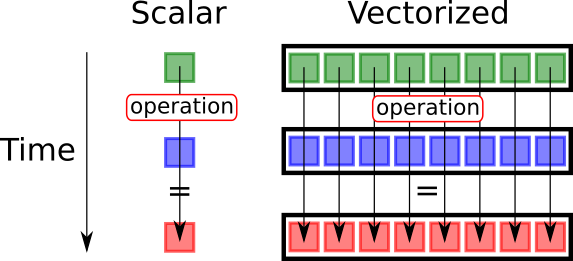
- It’s faster because your processor can do some operations over multiple values with one instruction
Dot syntax: broadcasting/vectorization
Vectorizing operations is easy in Julia: just use dot syntax (like in MATLAB)
This is actually called broadcasting in Julia
Dot syntax: math intuition
There is a mathematical intuition to make a distinction
- \(g(x) = x^2\) is a function \(\mathbb{R} \rightarrow \mathbb{R}\), i.e., mapping a scalar to a scalar
- But if \(z\) is, say, a \(6 \times 1\) vector: \(z \in \mathbb{R}^6\), it’s unclear what \(g(z)\) is
- What does the square of a \(6 \times 1\) vector even mean? Is it the square of each element? Is it a dot product with the vector itself? Something else?
- When you use the dot syntax
g.(1:2:11), you are telling Julia: apply functiongto each element in vector[1, 3, 5, 7, 9, 11]- If we needed a function to do something else with the whole vector, we need to write a different function for that
Dot syntax: we must pay attention to definitions!
- Julia will generally be picky about this: if you call a function that is defined for a scalar and give it a vector, you will get an error message
- This strictness (called “strong typed language”) is actually one of the reasons it gets so fast: it doesn’t need to spend time figuring out what kind of variable you give to it
- The
try/catchblock let’s you handle error messages within your program- If anything fails, you can program ways to handle errors
- We won’t be using it in the course; it’s here just because I have to handle it this way to generate slides. If you run this code, Julia REPL will give you a more informative error message
5. Scope
Scope
The scope of a variable name determines when it is valid to refer to that variable
- E.g.: if you create a variable inside a function, can you reference that variable outside the function?
- You can think of scope as different contexts within your program
The two basic scopes are local and global
Scope can be a frustrating concept to grasp at first. But understanding how scopes work can save you a lot of debugging time
Let’s walk through some simple examples to see how it works
Scope
First, functions have their own local scope
Scope
Locally scoped functions allow us to do things like:
Although xx was declared equal to 10 outside the function, the function still evaluated xx within its own scope at 5 (the value passed as argument)
Scope
But this type of scoping also has (initially) counterintuitive results like:
zz = 0What happened?
Scope
What happened?
The zz outside the for loop has a different scope: it’s in the global scope
The global scope is the outermost scope, outside all functions
The zz inside the function has a scope local to the loop
Since the outside zz has global scope, the locally scoped variables in the loop can’t change it
Scope
But hold on. If try the same loop outside a function, it will actually return 10, not 0. \(^{*}\)

That’s because this for loop sits in global scope
- It can get more complicated than that because there are soft and hard local scopes… but we don’t need to dwell on that
- The documentation has the details about the scope of variables
Scope
Generally, you want to avoid global scope because it can cause conflicts, slowness, etc. But you can use global to force it if you want something to have global scope
- This is almost always a bad practice, though!
Scope
Local scope kicks in whenever you are defining variables inside a function
Global variables inside a local scope are inherited for reading, not writing
Scope
We can fix looping issues with global scope by using a wrapper function that doesn’t do anything but change the parent scope so it is not global
6. Multiple dispatch
Multiple dispatch
Julia lets you define multiple functions with the same name but different types of input variables
This is useful because some operations have different steps depending on the context. For example
- Multiplication (
*) can work on scalars, vectors, matrices, and more complex types- By allowing different instructions depending on what type of variable is given, Julia makes it easier for user to use functions consistently
- But if you try to call a function with types of input variables it doesn’t know how to handle, it will throw an error
- This is usually the most common error you will encounter while learning Julia
Multiple dispatch
/ has MANY different methods for division depending on the input types! Each of these is a function specialized function that treats the inputs differently
- /(::Missing, ::Missing) in Base at missing.jl:122
- /(::Missing, ::Number) in Base at missing.jl:123
- /(x::BigInt, y::BigInt) in Base.GMP at gmp.jl:517
- /(x::BigInt, y::Union{Int16, Int32, Int64, Int8, UInt16, UInt32, UInt64, UInt8}) in Base.GMP at gmp.jl:566
General programming advice
Some concluding words on programming
There is really only one way to effectively get better at programming: PRACTICE
Yes, reading can help, especially by making you aware of tools and resources. But it’s no substitute for actually solving problems with the computer
Some concluding words on programming
How to get started with your practice?
My suggestion of an intuitive way: practice writing programs to solve problems you would know how to solve by hand
- The computer follows a strict logic that very often is different from yours
- Learning how to tell the computer to follow instructions and get to a destination you already know is a great way of learning
My personal favorite: Project Euler
Some concluding words on programming
Project Euler is a series of challenging mathematical/computer programming problems that will require more than just mathematical insights to solve. Although mathematics will help you arrive at elegant and efficient methods, the use of a computer and programming skills will be required to solve most problems.
Example of problems 1. If we list all the natural numbers below 10 that are multiples of 3 or 5, we get 3, 5, 6 and 9. The sum of these multiples is 23. Find the sum of all the multiples of 3 or 5 below 1000. . . .
- The prime factors of 13195 are 5, 7, 13 and 29. What is the largest prime factor of the number 600851475143 ?
You can type in your answer and it will tell you if it’s correct
Some concluding words on programming
More on coding practices and efficiency:
See JuliaPraxis for best practices for naming, spacing, comments, etc
See more Performance tips from Julia Documentation
What about ChatGPT, Claude, and other LLMs?
- You are lucky! You’re among the first cohorts learning to program with an available AI language model that is advanced enough to understand, explain, and generate code
- Currently, one of the best available services for that is called GitHub Copilot. It’s paid, but you can get it for free with an
.eduemail
But hold on. Don’t use this powerful resource without careful consideration
What about ChatGPT, Claude, and other LLMs?
But hold on. Don’t use this powerful resource without careful consideration
- This must be a complement, not a substitute for your programming skills
Why?
- For especialized scientific use, AI often produces buggy, incomplete, or outright incorrect code
- Before you use it accurately, you need to be familiar enough with programming logic and the language you are using to know when things are wrong
- These tools are improving fast, but they will always be imperfect
- There is an inherent limitation in translating ambiguous (natural) languages to non-ambiguous (formal) languages
- Treat it like a very smart intern who can do well-defined tasks very quickly
- But, to correctly supervise an intern, you need to know the job well yourself!
Advice on AI coding assistants
Here is my personal advice to you focusing on your the medium/long-term career as a researcher
- Do not use AI assistants to generate code you still cannot write and understand
- There’s too big of a risk of producing incorrect code
- It will place a low cap on your logical thinking for computational methods
- Once you advance and become familiar with programming structures, you can start relying in AI to speed up your coding
- For this course, coding assignments are relatively short, so I expect you to know what every line of code you write does
Advice on AI coding assistants
Here is my personal advice to you focusing on your the medium/long-term career as a researcher
- Use AI assistants to explain code to you or generate examples
- Throughout the semester, you will see many examples of algorithms
- AI can offer tremendous help explaining the inner workings of algorithms
- If you are a good programmer in one language, AI tools can also help you translate code
- Even in that case, I’d still recommend you start using it to explain code in the “new” language rather than simply generate code for you