class: center, middle, inverse <style type="text/css"> .pull-left { float: left; width: 48%; text-align: left; } .pull-right { float: right; width: 48%; text-align: left; } .pull-right ~ p { clear: both; } .pull-center { margin: 0 auto; width: 50%; text-align: left; } .pull-center ~ p { clear: both; } .pull-center-narrow { margin: 0 auto; width: 30%; text-align: left; } .pull-center-narrow ~ p { clear: both; } .pull-left-wide { float: left; width: 66%; text-align: left; } .pull-right-wide { float: right; width: 66%; text-align: left; } .pull-right-wide ~ p { clear: both; } .pull-left-narrow { float: left; width: 30%; text-align: left; } .pull-right-narrow { float: right; width: 30%; text-align: left; } .tiny123 { font-size: 0.40em; } .small123 { font-size: 0.80em; } .medium123 { font-size: 1.10em; } .large123 { font-size: 3em; } .huge123 { font-size: 6em; } .red { color: red; } .red123 { color: #b33d3d; } .green123 { color: #2c5c34; } .highlight { background-color: yellow; } .space-top { margin-top: 3cm; } </style> .large123[**A Perfect Storm: First-Nature Geography and Economic Development**] ### Christian Vedel, ### University of Southern Denmark .pull-center[ .center[ <p><i>These slides + full replication package from raw data to latex and final paper available at </i> <a href="https://github.com/christianvedels/A_perfect_storm">github.com/christianvedels/A_perfect_storm</a> <img src="Figures/github-mark-white.png" alt="Logo" style="vertical-align: middle; height: 20px;"> </p> *Updated paper available on [arxiv.org/abs/2408.00885](https://arxiv.org/abs/2408.00885)* ] ] --- class: middle, inverse .space-top[ # *Why is it that economic activity happens in some places rather than other places?* ] *(I will tell you something you already know: Geography matters)* ??? --- class: center, middle, inverse .pull-left-wide[ ### Distribution of Economic Activity across the world <img src="Figures/The_earth_at_night_greyscale.png" width="75%" style="display: block; margin: auto;" /> .small123[ *[Wikimedia Commons, retrieved from NASA Earth Observatory, 27 November 2012](www.commons.wikimedia.org/wiki/File:The_earth_at_night.jpg)* ] ] .pull-right-narrow[ ### Henderson et al (2018) - 24 physical geographical attributes ... - ...explain 47 pct of this - But how does it work? Is it just seeds? Is it contemporary? ] ??? - If you are born in certain places, you have worse opportunity - Simply loosing the geographical lottery gives you worse opportunities - Why? --- <img src="Figures/Map_nobg.png" width="75%" style="display: block; margin: auto;" /> ??? - This map essentially shows the entire story I am going to tell you today - Market access improved because of new port becoming available - Imagine being a merchant in one of these dots before 1834 - You would have to travel along the dotted line --- class: center ## Map <iframe src="https://www.google.com/maps/embed?pb=!1m14!1m12!1m3!1d704129.7470425251!2d8.826970647896832!3d56.880787313536544!2m3!1f0!2f0!3f0!3m2!1i1024!2i768!4f13.1!5e1!3m2!1sda!2sdk!4v1634159326111!5m2!1sda!2sdk" width="1200" height="500" style="border:0;" allowfullscreen="" loading="lazy"></iframe> --- class: middle .pull-left-wide[ # Where this came from - Covid, - Summer escape - Local history - Maritime Historian, Bo Poulsen, AAU + *In particular* Poulsen (2019, 2022) + This is in large a quantitative test of his work ] .pull-right-narrow[  ] --- ### Town of Thyborøn .pull-left-wide[  ] --- ### Local fish - 25 pct of catch in 2021 .pull-left-wide[ .pull-right-wide[  ] ] --- .space-top[ .pull-left-wide[ # A Perfect Storm - Time variation in first-nature geography: Causal effect of geography - **Data:** Population, occupation, demography (fertility/internal migration), archaeological findings ] ] -- .pull-left-wide[ .red123[ `\(\rightarrow\)` **First nature geography determines the location of prosperity** ] ] --- # Beyond seeds? .pull-left-narrow[ - Geography as seeds or active determinants? (Bosker, 2022) - Can institutions overcome the forces of geography? - Seeds well documented: Diamond (1997), Matranga (2024), Allen et al (2023), Bleakly & Lin (2012), Davis & Weinstein (2002) ] .pull-right-wide[  ] --- .center[ # Literature - geography versus institutions ] .pull-left[ ### Institutions vs geography - Institutions are the primary driver of economic development (Acemoglu et al., 2001) - Geography acts through institutions (Rodrik et al., 2004) - Geography plays a role (which is smaller than instituions) (Ketterer and Rodríguez-Pose, 2018) ] .pull-right[ ### Geography - Henderson et al. (2018): Geography explain 47 pct of nightlight variation - Even large disruptions does not change long-run outcomes (Davis and Weinstein, 2002) `\(\rightarrow\)` Path dependence or first nature geography? - Bleakly and Lin (2012): Path dependence is part of the answer - What about first nature? Extreme long-run: Diamond (1997); Allen et al. (2023); Matranga (2024) ] --- name: timeline # Timeline -- #### Pre-event: - 1085-1208: Natural western channel closed because of gradual land rises (since the last ice age) - Limfjord towns lacked far behind the rest of the country -- #### Event: - 1825: Breach of Agger Isthmus - 1834: Ships start consistently passing through a new natural channel - 1841: Independent trade rights to west Limfjord market towns - 1841-1860: 'Golden age of trade' - 1860-1900: Population growth + changed occupational structure  ??? - This newspaper clip is from a local newspaper - It is written with the hard to read 'Fraktur' font - ...And it is also in Danish - But if you trust me, I can tell you that it says that a ship arrived with coal from Newcastle - This is the type of traffic which was now possible. --- class: middle # Empirical strategy .pull-left-narrow[ `$$log(y_{it}) = Affected_i \times Year_t \beta_t + FE + \varepsilon_{it}$$` *Affected is:* - The **West** Limfjord, or - Improved **market access** after the breach ] ??? - Nicely exogenous event - Only concern is how we define being 'affected' --- <img src="Figures/Map_nobg.png" width="75%" style="display: block; margin: auto;" /> --- class: middle # Market Access .pull-left[ Based on cost distance from parishes to harbours: `$${MA}_p = \sum_{h \in H} [CostDist(p, h)]^\theta$$` - CostDist - Dijkstra's algorithm and 1/10 land/sea ratio - `\(\theta = -1\)` - Findings robust to other levels of `\(\theta\)` and Cost Distance function specificaitons. ] --- name: censusdata # Population and occupations: Census data .pull-left[ - Link Lives - Individual-level data for the years 1787, 1801, 1834, 1845, 1860, 1870, 1890 and 1901 - From this: Parish level population counts + occupations + other demographic info - New procedure to automatically make [HISCO labels](#hisco) - [OccCANINE](https://github.com/christianvedels/OccCANINE) [arxiv.org/abs/2402.13604](https://arxiv.org/abs/2402.13604)  ] .pull-right[ *Census, wikimedia commons*  ] --- name: str-presentation # Trade: Sound Toll Register (STR) .pull-left[ - Most ships to and from the Baltic region (1.8 mio. passages, 1497-1857) - Extract traffic for Denmark - Digitized by team at Gronningen (Veluwenkamp & Woude, 2009) - Only ships passing [Elsinore](#elsinor)  *Kronborg at Elsinore anno 1500, wikimedia commons* ] .pull-right[  *Page from Sound Toll Register in 1734 (www.rug.nl)* ] --- class: center, middle # First nature geography causes trade <img src="Figures/Ship_trafic.png" width="75%" style="display: block; margin: auto;" /> *Descriptive statistics from Sound Toll Registers* --- class: center, middle # Population increase .pull-left[ ### Market Access approach <img src="Figures/pop_ma.png" width="100%" style="display: block; margin: auto;" /> ] .pull-right[ ### Dummy approach <img src="Figures/pop_dummy.png" width="100%" style="display: block; margin: auto;" /> ] ??? - Rauch & Maurer (2022): 2.3 for panama canal --- class: middle .pull-left[ ## Results #### In 1901: - **Dummy approach:** 0.236 log points (26.7 percent) population growth - **Market Access approach:** 1.59 elasticity of first-nature market access to population size ] --- class: center # Occupational effect in 1901 (1/2) .pull-left[ <img src="Figures/All_occupations_dummy.png" width="90%" style="display: block; margin: auto;" /> ] .pull-right[ ### Results - Shift in occupational structure. - Most remarkable for Argiculture and Manufacturing .middle[ .small123[ #### Econometrics details - **HISCO coding?:** *OccCANINE* [arxiv.org/abs/2402.13604](https://arxiv.org/abs/2402.13604) - **Small changes?:** APE share: *Average partial effects as share of population* + *Answers changes to how common a profession is in a parish's population* - **Zeros?** Extensive + Intensive margin + asinh(x) + log(x+1) (Chen & Roth, 2023) - **Multiple testing:** Bonferoni correction ] ] ] ??? --- class: center # Occupational effect in 1901 (2/2) .pull-left-narrow[ - Spinners - Generic workers (factories) - Fishermen - Farmers (as default) ] .pull-right-wide[ <img src="Figures/Dummy_asi.png" width="90%" style="display: block; margin: auto;" /> ] --- class: center .pull-left[ ### Born in differen county #### Dummy approach <img src="Figures/born_different_share_Dummy.png" width="50%" style="display: block; margin: auto auto auto 0;" /> #### MA approach <img src="Figures/born_different_share_MA.png" width="50%" style="display: block; margin: auto auto auto 0;" /> ] -- .pull-right[ ### Child/woman ratio #### Dummy approach <img src="Figures/fertility_Dummy.png" width="50%" style="display: block; margin: auto auto auto 0;" /> #### MA approach <img src="Figures/fertility_MA.png" width="50%" style="display: block; margin: auto auto auto 0;" /> ] --- class: middle # Geography and prosperity .pull-left-wide[ - Can we conclude anything about well being of people? No - But: + Higher productivity jobs + Higher population density + Driven by fertility (in a post-Malthusian economy Jensen et al, 2022) + Points to increased levels of prosperity - *Geomorphology* is determines prosperity ] --- class: center, middle, inverse # What about external validity? --- # The reverse natural experiment .pull-left-wide[ - The Limfjord also had a western opening in the Viking age. - Ideal hub for viking fleets heading west towards England (Matthiessen 1941; Rasmussen, 1966) - Northwestern Denmark in 1100s is very different from ditto in 1800s - Between 1086 and 1208 the channel closed up (historical + geological sources) **Data?** - Just use register data! - Turning dating range + coordinate into panel of economic activity ] .pull-right-narrow[ 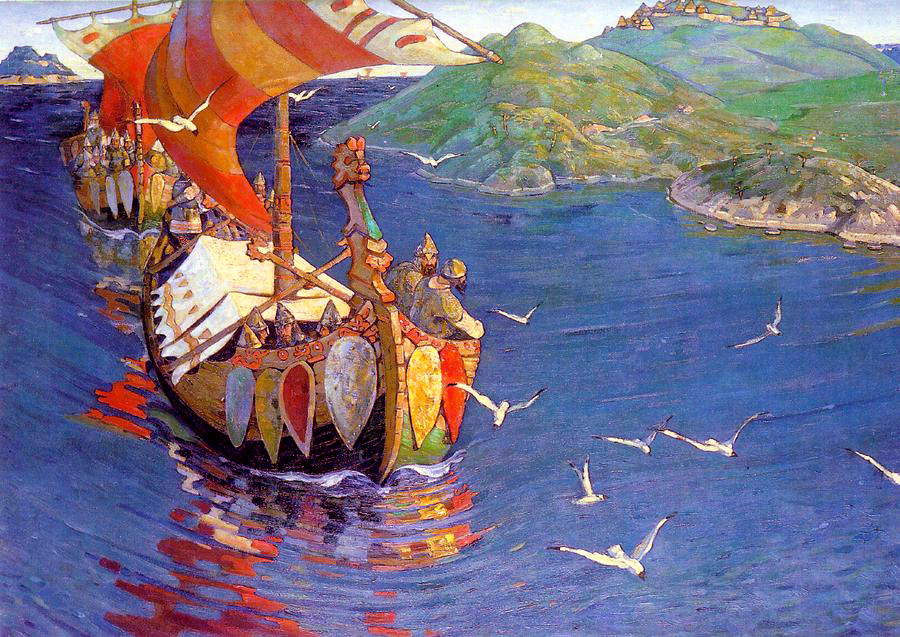 *'Overseas Guests', Roerich (1901)* 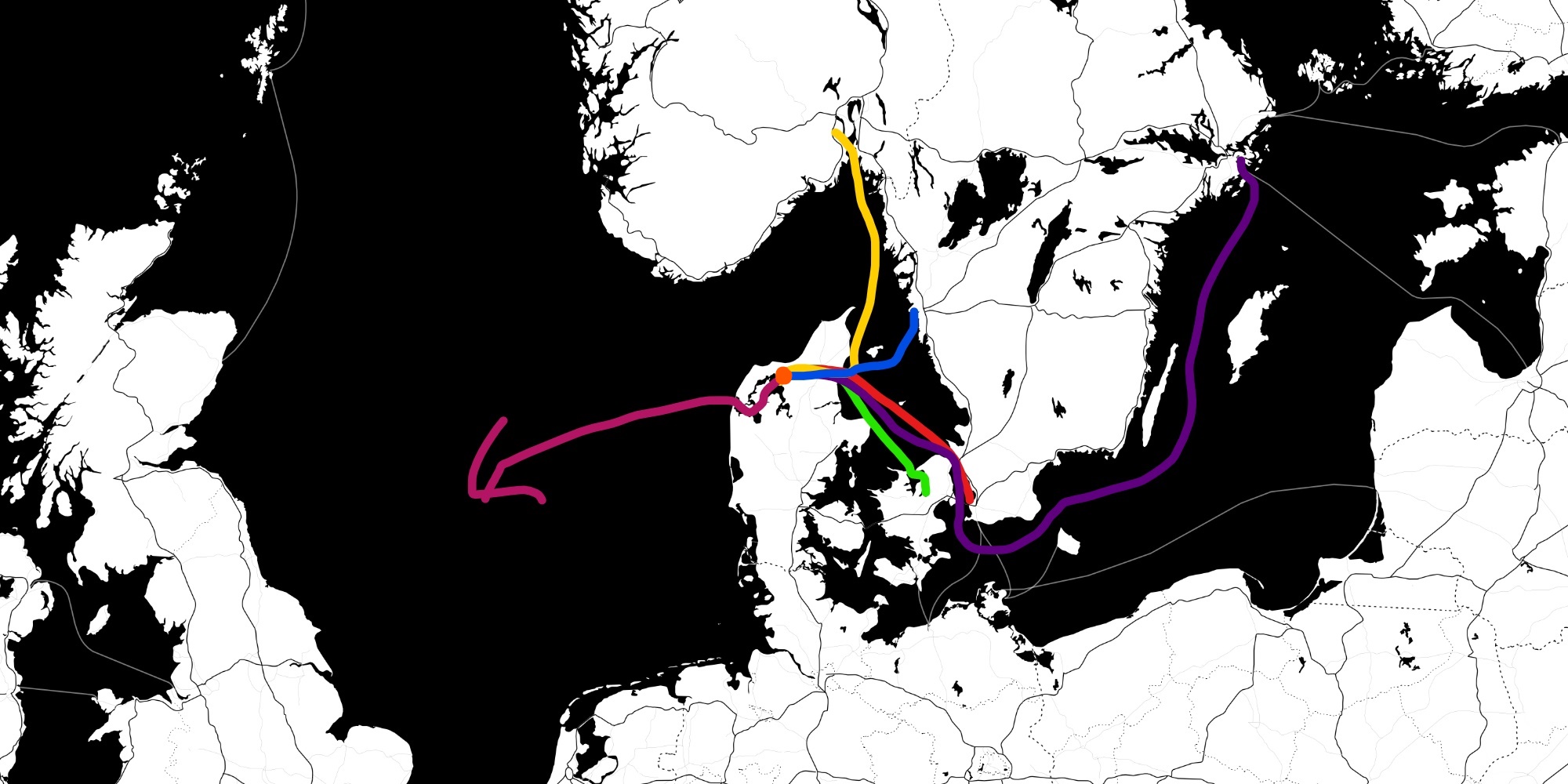 *maps.stamen.com* ] --- # Descriptive evidence <img src="Figures/Arch_descriptive.png" width="75%" style="display: block; margin: auto;" /> --- # Some considerations about archaeological data -- .pull-left[ ### Problems 1. If a coin finding is dated to the period 745-1066, in which decade does it then count? + *All of them?* + What about a coin finding dated to between 1030 and 1039? 2. Soil type shapes the economy but also availability of archaeological remains + Huge selection problem 3. Why would coins be left? + Trade? Distress? ] -- .pull-right[ ### How to address them 1. Use Bayesian Monte Carlo sampling procedure to estimate: `\(Pr(\{c\}|t)\)` from `\(Pr(t|c)\)` + *Intution: Interpret arhcaeological dating as a probability distribution* 2. Matching + *Greedy propensity score matching - same soil profiles* 3. Use several different outcomes + Building, coins, other? ] --- class: middle .center[ ## Effect on coin findings ] .pull-left-wide[ <img src="Figures/arch_dummy_coins.png" width="75%" style="display: block; margin: auto;" /> ] --- class: middle .center[ ## Effect on buildings findings ] .pull-left-wide[ <img src="Figures/arch_dummy_buildings.png" width="75%" style="display: block; margin: auto;" /> ] --- # Matching *Based on greedy propensity score matching* .pull-left[ .pull-left[ 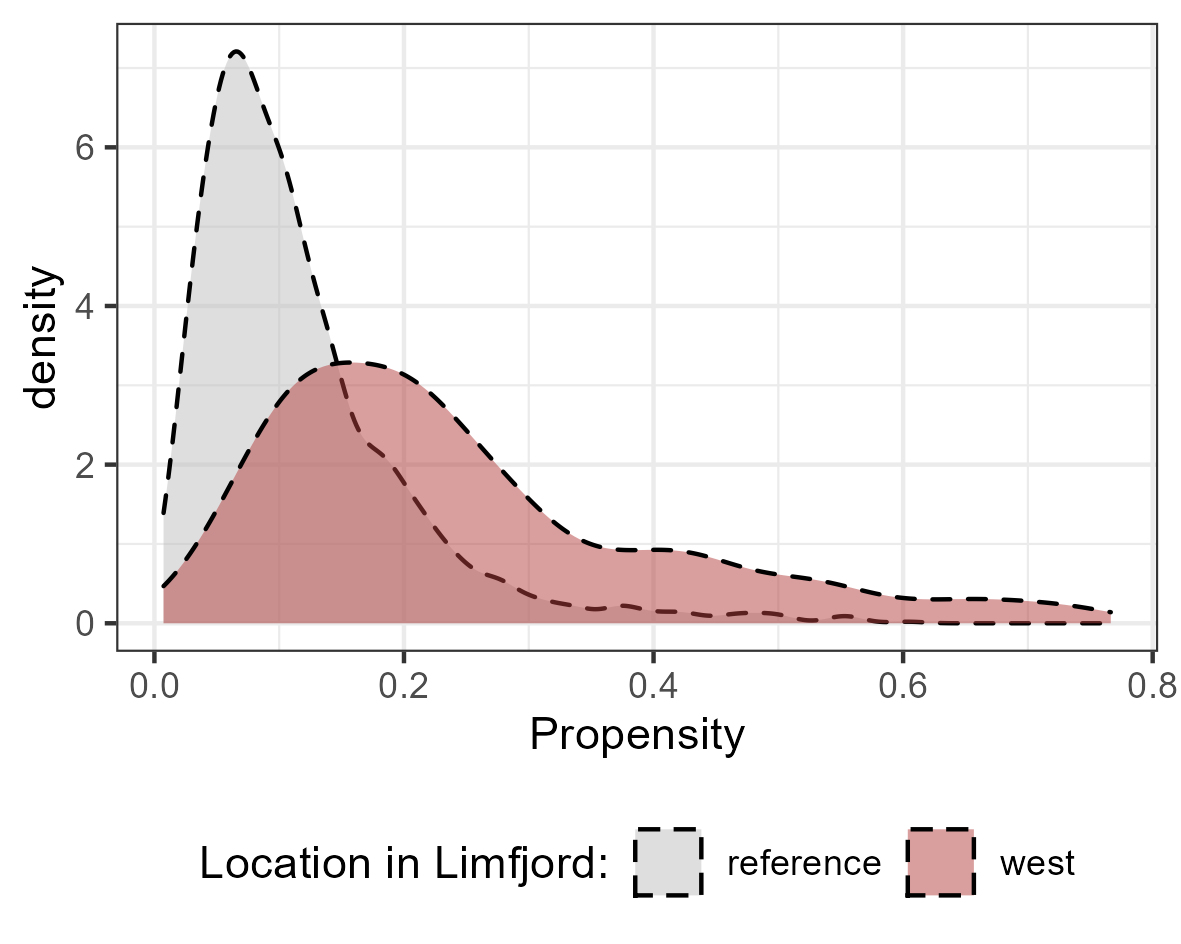 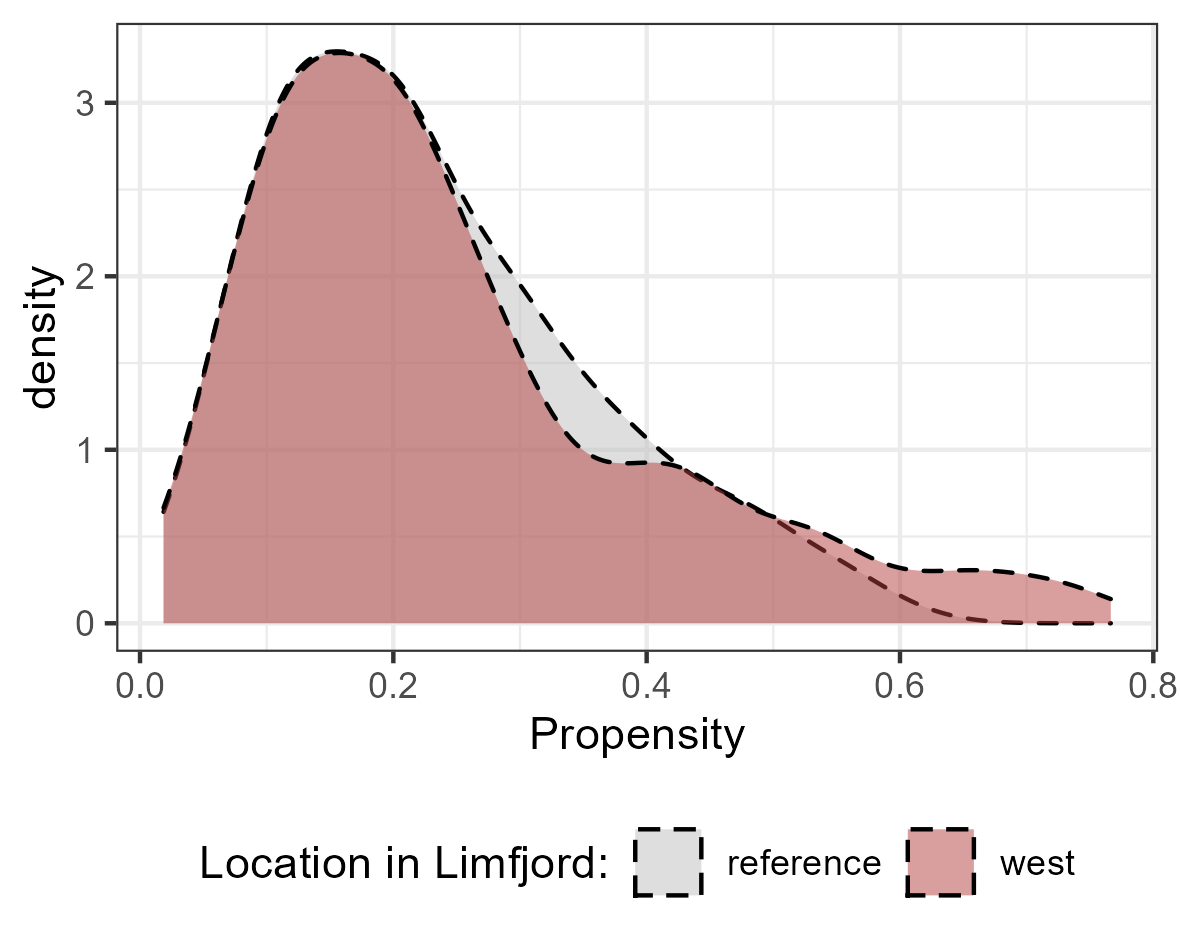 ] ] -- .pull-right[  *Regression table: Effect across all specificaitons* ] --- name: other-results # Conclusion .pull-left[ - **Does first nature influence development beyond eventual path dependence? Yes** - Storm led to a channel and improved connectivity in 1834 - The population grew 26.7 percent in a generation in affected parishes - Intrinsic growth (fertility), fishing and manufacturing - (Temporal) external validity: Closing of similar channel in 1200 `\(\rightarrow\)` Similar (reverse) effect ] .footnote[ **Email**: christian-vs@sam.sdu.dk;<br> **BlueSky**: @christianvedel.bsky.social;<br> **Twitter/X**: @Christian Vedel<br> Feel free to reach out :-) ] .pull-right[ .pull-left[  ] .pull-right[  ] *Morsø cast iron wood stove. Morsø iron foundry opened in 1853, right where it would benefit from British Coal and Swedish Iron* ] --- count: false class: center, middle # Appendix --- name: new-ports # New ports [Back](#instmech)  --- name: railways1 # Railways (1/2) [Back](#instmech) .pull-left[  ] .pull-right[  ] Source: Fertner (2013) --- name: railways2 # Railways (2/2) [Back](#instmech) .pull-left[  ] .pull-right[  ] Source: Fertner (2013) --- name: elsinor # Elsinor .center[ <iframe src="https://www.google.com/maps/embed?pb=!1m14!1m12!1m3!1d3743.038856836935!2d12.616720634729397!3d56.03904113734528!2m3!1f0!2f0!3f0!3m2!1i1024!2i768!4f13.1!5e1!3m2!1sda!2sdk!4v1655049802848!5m2!1sda!2sdk" width="600" height="450" style="border:0;" allowfullscreen="" loading="lazy" referrerpolicy="no-referrer-when-downgrade"></iframe> ] [Back to STR](#str-presentation), [Back to results](#str-results) --- name: Rob_comp ## Robustness: Comparison groups .pull-left[ #### MA approach  ] .pull-right[ #### Dummy approach  ] [Back](#pop) .footnote[ **Definitions:** A: <5km to coast; B: Copenhagen excl.; C: Control >100 km from Limfj.; D: <5km to Market town ] --- name: all-paramMA ## Robustness: Parameter choices <img src="Figures/Multiverse_MA_param.png" width="60%" style="display: block; margin: auto;" /> [Back](#pop) --- name: fish # Environmental impact .pull-left-wide[ .pull-right-wide[  ] ] --- name: newspapers # Newspapers .pull-left[ - Based on all newspapers in published in the period ] .pull-right[  ] --- name: instmech # Mechanism: Adaptation .pull-left[ [Back](#mechanism1) *Theoretical mystery desribed by Redding and Turner (2015)* #### Historiography: - 1840s: [New ports were constructed in all west Limfjord market towns](#new-ports) - 1841: Independent rights for international trade - 1852: First ever Danish steam route to England - 1856-1861: Construction of the Frederik VII canal at Løgstør - 1860-1900: [Railways](#railways1) and highways - 1875-1933: Groins to stabilise the channel (and coast) ] .pull-right[  *Milton (1884) Frederik VII canal*  *'Placat' announcing trade rights of Limfjord market towns* ] --- name: hisco # New occupational data [Back](#censusdata) .pull-left[ - Censuses 1787-1901 contain HISCO for some years (3.7 mio. observations) - Training data `\(\rightarrow\)` 13.5 mio. records. - Accuracy: 94 pct + Multlingual ] .pull-right[ - Check out [OccCANINE](https://github.com/christianvedels/OccCANINE) - [arXiv: Breaking the HISCO Barrier: Automatic Occupational Standardization with OccCANINE](https://arxiv.org/abs/2402.13604) w. Christian M. Dahl and Torben Johansen ]  --- class: center, middle name: appendixarch # Archaeological evidence details .footnote[ [Back](#arch) ] --- .pull-left[ ## About the data - Administrative database of all archaelogical sites and finds - Managed by ministry of culture - 321 generic types of findings. E.g. coins - 1940 dated sites with coins between 750 and 1500 - Panel construction: + **Innovation:** Monte Carlo to estimate `\(P_i(Coin|t)\)` + Probability that a coin finding was generated at a specific time ] .pull-right[ ## Data example   *Coins, wikimedia commons* ] .footnote[ [Back](#arch) ] --- # Estimator of coin probability .pull-left[ - **Objective:** We want to know *how likely it is that coin was left at a particular time `\(t\)`* - **What we have:** Observations of individual coin findings and a distribution of times `\(t\)`, which are likely for a specific coin finding in a place `\(i\)` **In equation form:** - What we have: `\(P_i(t|c)\)`: Probability of `\(t\)` given one coin - What we want: `\(P_i(\{c\}|t)\)`: Probability of *any* coins in time `\(t\)` ] -- .pull-right[ ### The solution Bayes formula and Monte Carlo - Simple to sample from this distribution - Sample `\(t\)` from each coin - Count frequency of coin findings `$$P(\{c\}|t)=\left[1-\prod_{c=1}^{K_i} \left( 1 - P(t|c) \right)\right] P(\{c\})$$` where it is assumed that `\(P(t|c)\sim \mathscr{U}(Year_{min}^c; Year_{max}^c)\)` or `\(P(t|c)\sim \mathscr{N}(\mu_c, \sigma_c),\)` `\(\sigma_c=\frac{(Year_{max}^c - Year_{min}^c)}{1.96}\)` ] --- ### All indicators .pull-left-wide[ 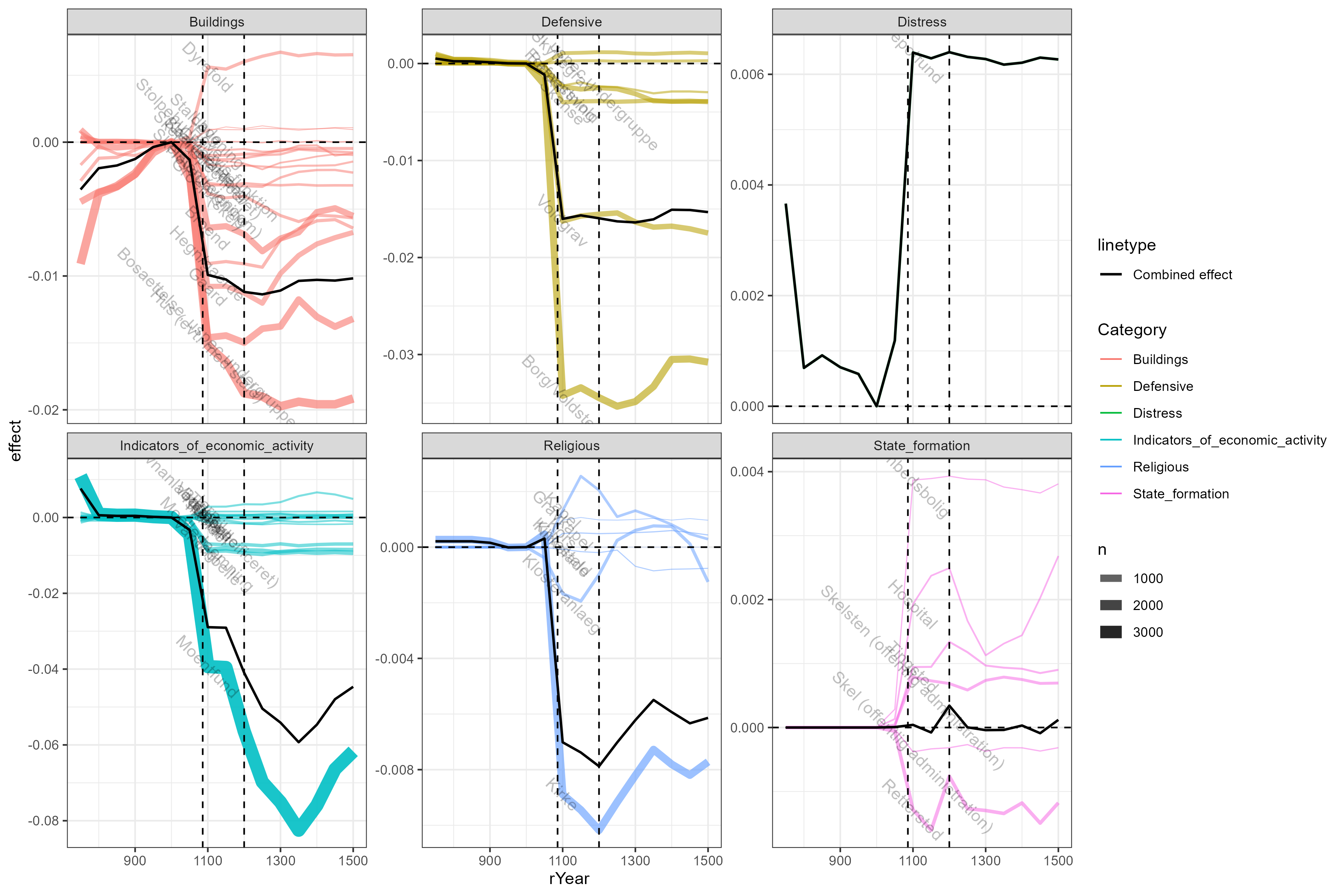 ] --- name: matching_coins #### Coin findings (matched sample) <img src="Figures/arch_dummy_coins_matched.png" width="80%" style="display: block; margin: auto;" /> [Back](#arch1) --- name: matching_buildings #### Building findings (matched sample) <img src="Figures/arch_dummy_buildings.png" width="80%" style="display: block; margin: auto;" /> [Back](#arch2) --- ### Safer, more convenient harbours are nice .pull-left-wide[  ]