Petros Paplomatas was born in Katerini, Greece in 1987. He received his diploma in 2011 from the Biomedical Sciences Department of the School of Health Sciences of the International Hellenic University-IHU. He received his M.Sc. diploma in Biomedical and Molecular Sciences in the Diagnosis and Treatment of Diseases in 2021 from the Department of Medicine at Democritus University of Thrace. He received his second Master of Science in Bioinformatics and Neuroinformatics in 2023 from the Hellenic Open University. He is now a Ph.D. candidate at Ionian University's department of informatics. His research interests are in the fields of bioinformatics and systems biology. His research focuses on developing novel artificial intelligence or feature selection algorithms for the identification of potential biomarkers for early diagnosis and the development of web interactive applications for this purpose.
LIST OF PUBLICATIONS
2025 - Bayesian subset-based gene selection for biomarker discovery in high-dimensional data. Academia Molecular Biology and Genomics, 2(2). Link
2025 - Epidermal growth factor receptor specific immunotherapy for SHH medulloblastoma tested in an in vitro blood-brain-barrier model. Cancer Treatment and Research Communications. https://doi.org/10.1016/j.ctarc.2025.100950
2025 - Enhancing Nanopore cfDNA diagnostics of pediatric brain tumors with machine learning. Klinische Pädiatrie, 237(03), 0060.
2024 - Enhancing Metabolic Syndrome Detection through Blood Tests Using Advanced Machine Learning. Eng, 5(3), 1422-1434. https://doi.org/10.3390/eng5030075
2024 - Recent Computational Approaches in Understanding the Links between Molecular Stress and Cancer Metastasis. BioMedInformatics, 4(3), 1783-1806. https://doi.org/10.3390/biomedinformatics4030098
2024 - Estimation of Low-Density Lipoprotein (LDL) values using equations and Machine Learning and variance calculation of LDL and Atherogenic Index of Plasma (AIP). Academia Molecular Biology and Genomics, 1(1). https://doi.org/10.20935/AcadMolBioGen7443
2024 - Feature selection in single-cell RNA sequencing data: a comprehensive evaluation. Academia Biology, 2(3). https://doi.org/10.20935/AcadBiol7324
2024 - Molecular Dynamics of Stress in Chronic Fatigue Syndrome Through a Gene-Level Analysis. Academia Molecular Biology and Genomics, 1(1). https://doi.org/10.20935/AcadMolBioGen7314
2023 - An Ensemble Feature Selection Approach for Analysis and Modeling of Transcriptome Data in Alzheimer's Disease. Applied Sciences, 13(4), 2353. https://doi.org/10.3390/app13042353
2023 - Atypical neurofibromas reveal distinct epigenetic features with proximity to benign peripheral nerve sheath tumor entities. Neuro-oncology, 25(9), 1644-1655. https://doi.org/10.1093/neuonc/noad053
2023 - Are Complete Blood Count Parameters Associated with Climate and Environmental Factors? A Retrospective Study in the General Population of Fokis, Greece. Environmental Sciences Proceedings, 26(1), 163. https://doi.org/10.3390/environsciproc2023026163
2023 - Early Alzheimer's Prediction Using Dimensionality Reduction Techniques. In Handbook of Computational Neurodegeneration (pp. 1). Springer. https://doi.org/10.1007/978-3-319-75479-6_65-1
2023 - Applying SCALEX scRNA-Seq Data Integration for Precise Alzheimer's Disease Biomarker Discovery. In IFIP International Conference on Artificial Intelligence Applications and Innovations (pp. 294-302). Springer Nature Switzerland Cham. https://doi.org/10.1007/978-3-031-34171-7_23
2023 - Molecular and clinical characterization of atypical neurofibromas. Brain Pathology, 33.
2022 - A Comparison of the Various Methods for Selecting Features for Single-Cell RNA Sequencing Data in Alzheimer's Disease. In Worldwide Congress on "Genetics, Geriatrics and Neurodegenerative Diseases Research" (pp. 241-246). Springer International Publishing Cham.
2022 - Development of an R package for the calculation of LDL cholesterol using existing equations and machine learning methods. Under Review.
2024 - An interactive web app for the identification of robust genes-level biomarkers for complex diseases. In Development.
SCIENTIFIC ACTIVITIES
§ Invited Talks at International Conferences
GeNeDis 2022 5th worldwide conference on "Genetics, Geriatrics and Neurodegenerative Diseases Research". Topic: An ensemble feature selection approach for identifying Alzheimer's Disease Biomarker .
Fosscomm 2022 – Fosscomm 2022 (Free and Open-Source Software Communities Meeting). Topic: A Tool guide for the Identification of more robust genes-level drug targets and biomarkers for complex issues.
§ Talk Lectures
2023
Master of Science course, named "Stem Cells and Regenerative Medicine. Topic: Introduction to R programming language and development interactive application with Shiny.
2022,2024
Master of Science course, named "Digital Health and Analytics: Clinical Trial and Processes Modeling". Topic: Development interactive application for Biological analysis with Shiny package.
2022,2023,2024
Master of Science course, named "Biomedical and Molecular Sciences: Diagnosis and Treatment". Topic: Gene Expression Analysis
SOFTWARE
2023
ScGenesElite: A tool-guide for the identification of more robust genes-level drug targets and biomarkers for complex diseases.
This application offers a flexible platform for the identification of dominant genes in a single-cell RNA-sequencing (scRNA-seq) dataset that operate as disease biomarkers.
It uses statistical, machine-learning, and cutting-edge feature selection approaches for scRNA-seq data.
The feature selection operation modes include 15 different methodologies, covering a broad range of such approaches. The extracted gene list is further examined for enrichment in various biological and pharmacological features.
A heatmap according to the cell type or the disease state, an enrichment analysis, KEGG molecular pathways, PPI networks, and similarity graphs could be generated from isolated genes to provide a better understanding of the potential biomarkers and molecular interactions that are involved.
Welcome to the GenesRanking package! This guide will lead you through the analysis of scRNA-seq using GenesRanking, a tool for identifying potential biomarkers in scRNA-seq data.
2022
LDLcalc: Calculate and Predict the Low Density Lipoprotein Values.
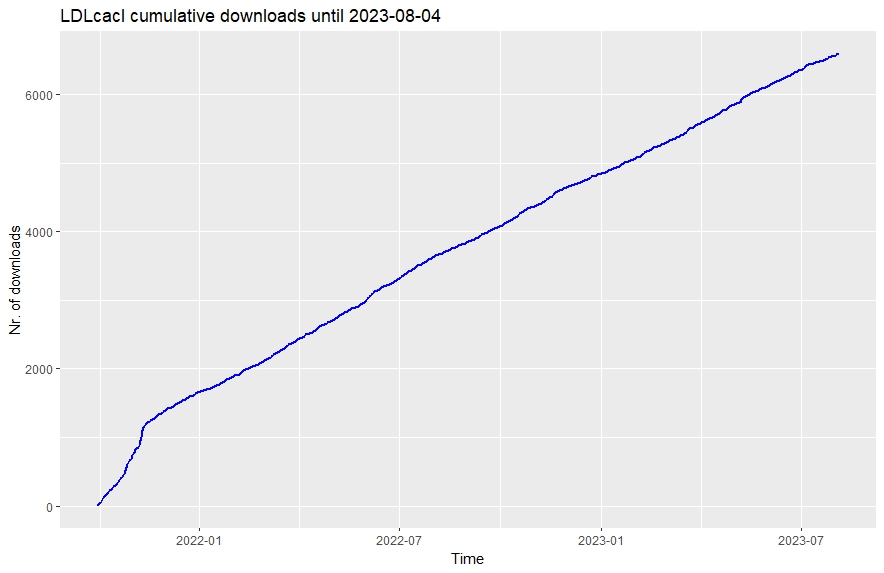
Almost 7,000 individuals have downloaded the LDLcalc Package.