Kinematic’s
Symbols
-
\$V\$ or \$V_{f}\$ → Final velocity
-
\$a\$ or \$\vec{a}\$ → Acceleration
-
\$t\$ → Time
-
\$V_{0}\$ → Initial Velocity
-
\$\overline{S}\$ → Average Speed
-
\$X_{F}\$ → Final Position
-
\$\Deltax\$ → Displacement of x axis
-
\$\Deltay\$ → Displacement of y axis
-
\$\vec{V_{a}}\$ → Average Velocity
-
\$S_{i}\$ → Instantaneos Speed
-
\$V_{i}\$ → Instantaneos Velocity
-
\$X_{0}\$ → Initial Position
-
\$V_{t}\$ → Terminal Velocity
-
\$\vec{S}\$ → Displacement
-
\$\vec{V}\$ → Vector
-
\$S_{a}\$ → Speed Average
-
\$w\$ → weight
Equations
Basic
-
\$V = V_{0}+at\$
-
\$(\Deltax or \Deltay) = \frac{V + V_{0}}{2}t\$
-
\$(\Deltax or \Deltay) = V_{0}t + 1/2at^2\$
-
\$V^2 = V_{0}^2 + 2a\Deltax\$
Extra
-
\$\vec{V} = \vec{S}/t\$ or \$r = d/t\$
-
\$\vec{V_{a}} = \frac{\Deltax}{t}\$
-
\$\vec{a} = \frac{\Delta\vec{V}}{t}\$
-
\$a = \frac{V_{f} - V_{i}}{\Deltat}\$
-
\$\vec{V_{a}} = \frac{V_{f} + V_{i}}{2}\$ ???
-
\$\vec{S} = (\vec{V_{a}})\Deltat\$
-
\$\vec{S} = \frac{V_{f}^2-V_{i}^2}{2\vec{a}}\$
-
\$2\vec{a}\vec{s} = V_{f}^2 - V_{i}^2\$
-
\$\DeltaV = a\Deltat\$
-
\$\frac{\Deltaa}{\Deltat} = jerk\$
-
\$V_{i} = V_{f} - a\Deltat\$
-
\$\Deltat = \frac{V_{f} - V_{i}}{a}\$
-
\$S_{a} = \frac{\text{distance}}{\Deltat}\$
| If the divisor is t then it is assumed to be \$\Deltat\$ |
| kinematic formulas are only accurate if the acceleration is constant during the time interval considered |
2D Projectile Motion
There’s no acceleration in the horizontal direction since gravity does not pull projectiles sideways
-
\$Delta x=v_xt \quad\$
An object can start with a horizontal component of velocity, yet have zero vertical component of velocity.
Instentaneos Rate of Change
Force
Symbols
-
\$\vec{F}\$ → Force of Gravity
-
\$g\$ → Acceleration of Gravity
-
\$m\$ → mass of object
-
\$r\$ → distance between objects
-
\$\vec{a_{g}}\$ → acceleration due to gravity
Equations
-
\$\vec{F} = m \cdot g\$
-
\$\vec{F} = m \cdot a\$
-
\$a = \vec{F}/m\$
-
\$a = g\$
-
\$\vec{F} = G \frac{m_{1}m_{2}}{r^2}\$
-
\$w = \frac{m}{g}\$
Gravity
-
\$m\$ → Mass of the Earth
-
\$r\$ → Radius of the Earth
Temrinal Velocity
-
\$V_{t}\$ represents terminal velocity
-
\$m\$ is the mass of the falling object
-
\$g\$ is accleration due to gravity
-
\$C_{d}\$ is the drag coefficent
-
\$p\$ is the density through which th object is falling
-
\$A\$ is the projected area of the object
Graphing
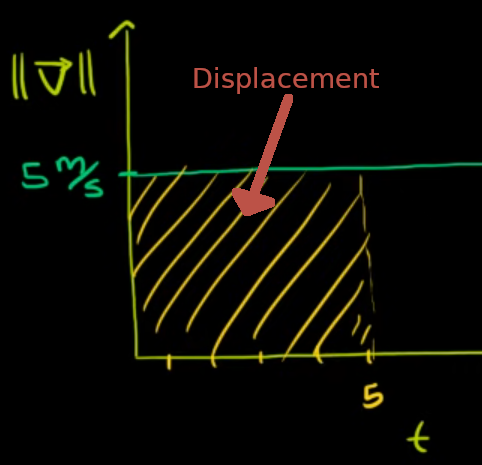
Velocity vs. Time Graphs
-
Slope is acceleration and a way to find instentaneos velocity
-
Area is displacement
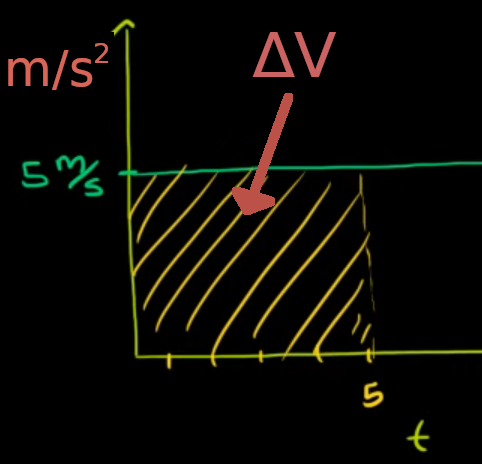
Acceleration vs. Time Graphs
-
Slope is jerk
-
Area is change in velocity
-
Typical y-axis: \$m/s^2\$
Using Quadradic Formula
Links
https://phys.libretexts.org/Bookshelves/University_Physics/University_Physics_(OpenStax)/Book%3A_University_Physics_I_-_Mechanics_Sound_Oscillations_and_Waves_(OpenStax)/11%3A__Angular_Momentum/11.02%3A_Rolling_Motion