Dot Product
inner-product
\[\overrightarrow{a} \cdot \overrightarrow{b} \\
\left[ \begin{array}{c}
a_{1} \\
a_{2} \\
\vdots \\
a_{n}
\end{array} \right]
\cdot
\left[ \begin{array}{c}
b_{1} \\
b_{2} \\
\vdots \\
b_{n}
\end{array} \right]
=
a_{1} * b_{1} + a_{2} * b_{2} + * a_{n} * b_{n}\]
normal vector and dot procuct
A normal vector has a magnitude of one and can point in any direction. The dot product of the normal vector and a point can tell you the distance that point is in that direction from the starting point of the normal vector.
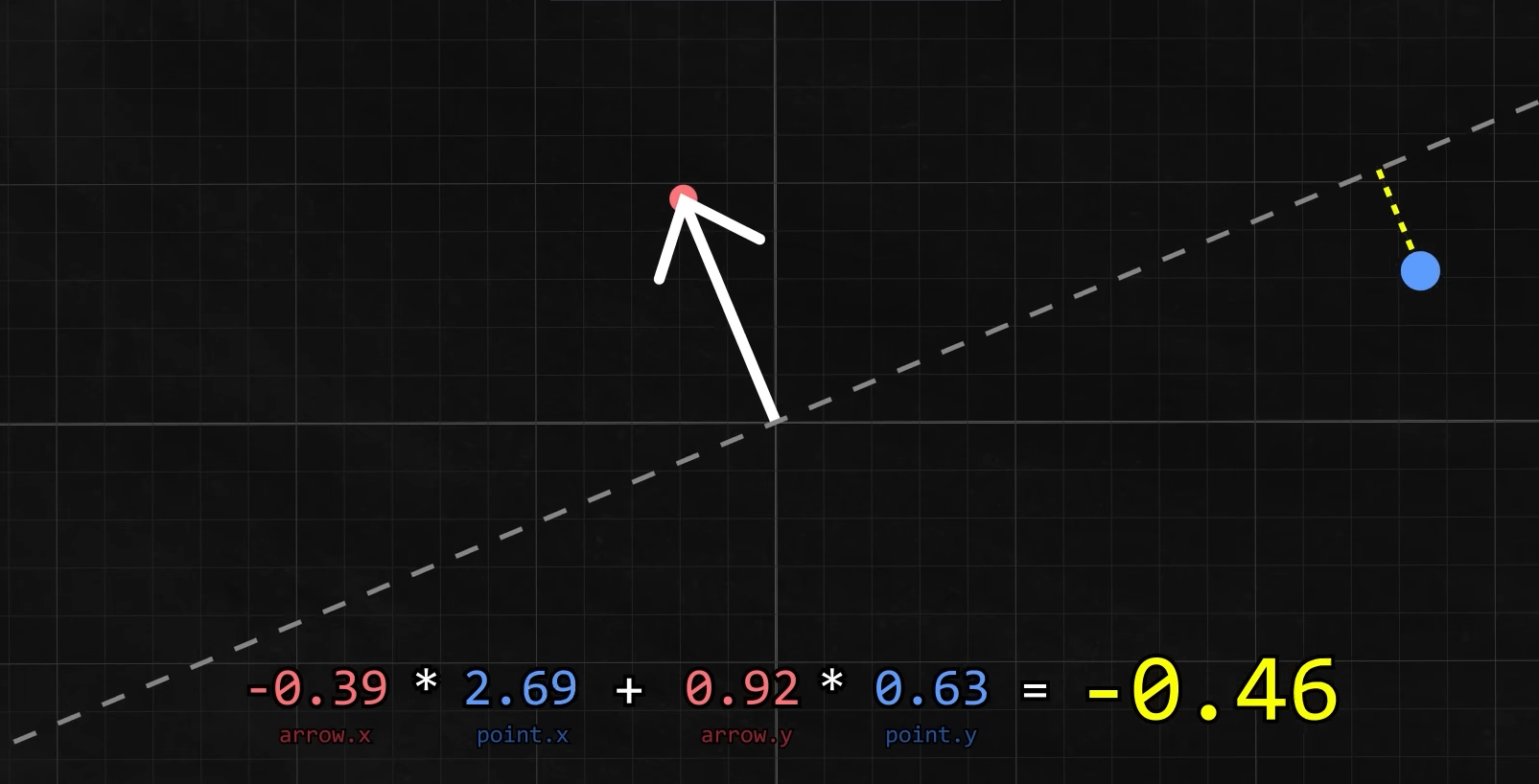
\[a = normal vector \\
b = point \\
\\
a.x * b.x + a.y * b.y = distance\]
Matrix Multiplication
\[A \otimes B = C
\\
A =
\left[\begin{array}{a}
a_{11} & a_{12} \\
a_{21} & a_{22} \\
\end{array}\right]
B =
\left[\begin{array}{b}
b_{11} & b_{12} & b_{13} \\
b_{21} & b_{22} & b_{23} \\
\end{array}\right]
\\
C =
\\
\left[\begin{array}{c}
(a_{11} * b_{11}) + (a_{12} * b_{21}), & (a_{11} * b_{12}) + (a_{12} * b_{22}), & (a_{11} * b_{13}) + (a_{12} * b_{23}) \\
(a_{21} * b_{11}) + (a_{22} * b_{21}), & (a_{21} * b_{12}) + (a_{22} * b_{22}), & (a_{21} * b_{13}) + (a_{22} * b_{23})
\end{array}\right]\]
Demension Rules
\[B = p \times q
\\
A = m \times n\]
\(n\) has to be equal to \(p\). The demensions of \(C\) is \(m \cdot q\)
Finding the Magnitude of a Vector
\[||\overrightarrow{a}|| = \sqrt{a_{1}^2 + a_{2}^2 + \dots a_{n}^2}\]
Identity Matrix
One’s are on the diagonal from top left to bottom right. Every other element is zero
\[\left[\begin{array}{a}
1 & 0 & 0 \\
0 & 1 & 0 \\
0 & 0 & 1 \\
\end{array}\right]\]
Inverse Matrix
When a matrix is multiplied by an inverse matrix the result is an identity matrix
Angles
orthogonality (right angles)
If the dot product of two vectors is equal to zero then the rays must be perendiculator to each other
Fiding the angle between two vectors
\[\frac{u \cdot v}{||u|| \cdot ||v||} = cos(\theta)\]
The result is the x value of the unit cirle, from that you can determine the y value of the unit circle and the angle.