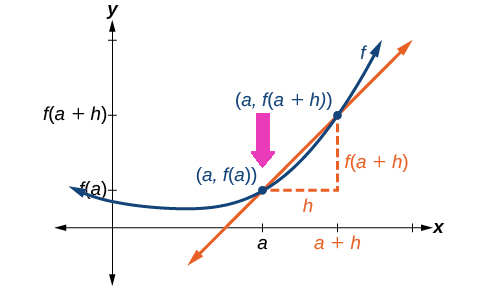
Derivative Formula
\$\lim_{h \to 0} \frac{f(a+h) - f(a)}{h} = f'(a)\$
Basic Rules
Constant Rule
\$\frac{d}{dx} [c] = 0\$
Power Rule
\$\frac{d}{dx} [x^n] = nx^(n-1)\$
Product Rule
\$\frac{d}{dx} [f(x)g(x)] = f'(x)g(x) + f(x)g'(x)\$
Quotient Rule
\$\frac{d}{dx} [\frac{f(x)}{g(x)}] = \frac{f'(x)g(x) - f(x)g'(x)}{(g(x))^2}\$
Chain Rule
\$\frac{d}{dx} [f(g(x))] = f'(g(x)) * g'(x)\$
Finding Critical numbers
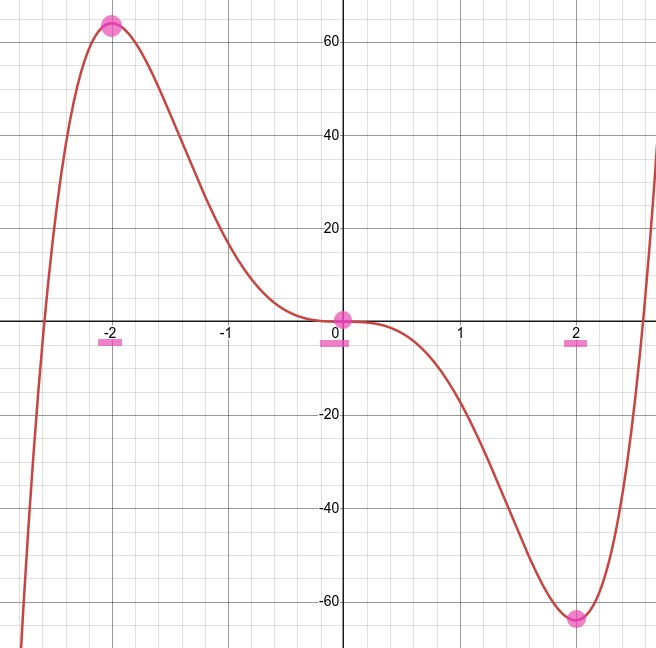
Find the critical numbers of
\$f(x) = 3x^5 - 20x^3\$
-
Find the first derivative of f using the power rule.
\$f(x) = 3x^5 - 20x^3
\$
\$f'(x) = 15x^4 - 60x^2\$
-
Set the derivative equal to zero and solve for x.
\$15x^4 - 60x^2 = 0
\$
\$15x^2(x^2 - 4) = 0
\$
\$15x^2(x+2)(x-2) = 0
\$
\$15x^2 = 0\ \ or\ \ x + 2 = 0\ \ or\ \ x - 2 = 0
\$
\$x = 0\ \ or\ \ x = -2\ \ or\ \ x = 2\$
These three X-Values are crtical number of f.
Trigonometric Derivatives
-
\$\frac{d}{dx}\[\sinx] = \cosx\$
-
\$\frac{d}{dx}\[\cosx] = -\sinx\$
-
\$\frac{d}{dx}\[\tanx] = \sec^2x\$
-
\$\frac{d}{dx}\[\secx] = \secx\tanx\$
-
\$\frac{d}{dx}\[\cotx] = -\csc^2x\$
-
\$\frac{d}{dx}\[\cscx] = -\cscx\cotx\$