Standard Form of a Polynomial
\$a_{n},a_{n-1},a_{n-2}\$ are coefficients of \$x^n,x^(n-1),x^(n-2)\$ and constant term respectively and it should belong to real number (\$\exists\mathbb{R}\$).
Types of Polynomials
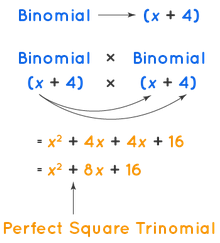
Binomial
Quadradic Equation
Line Slope-Intercept Form
- m
-
slope
- b
-
y-intercept
Line Point-Slope Form
I you have one point of the line and a slope you can figure out more points on the line with this formula
- m
-
slope
- \$x_{1},y_{1}\$
-
any pont on the line
Zeros of Polynomial (Roots of the equation)
Values of the variable such that the polynomial equals 0. Often represented as \$\alpha\$, \$\beta\$, and y respectively.
Finding the numnber of total real zeros
The degree of the polynomial represents the total number of real zeros.
Finding the numnber of positive real zeros
- Descrates Rule of Signs
-
The number of positive real zeros is either equal to the number of sign changes, or less a positive even integer
According To Descartes Rule of signs The numnber of positive real zeros could be 2, because there were to sign changes, or 0 because 2 - 2 is zero and 2 is a positive even integer.
Finding the number of negative real zeros
First look at the equation as if you added a negative symbol to x.
The number of negative real zeros, is either equal to the number of sign changes, or less than a positive even integer in the equation.
There is one sign change so the answer is one. One is the only answer because one minus two would be negative one and you cannot have a negative number of negative real zeros.
Finding the number of imaginary real zeros
In this case if we look at the chart, we know that there has to be three total real zeros. If we fall into the situation where there are 0 positive real zeros than there would have to be 2 imaginary real zeros.
| Pos | Negative | Imaginary | Total |
|---|---|---|---|
2 |
1 |
0 |
3 |
0 |
1 |
2 |
3 |
Factoring Trinomials
Leading Coeficient Of One
-
Find two numbers that when multiplied together equal the constant term but when added together equal the first degree term.
-
Take the two numbers from step one and put it in the multiplication of two binomials in the form of \$(x+a)(x+b)\$, where
ais the first number number andbis the second term.
Example:
- answer
-
\$(x+3)(x+2)\$
Leading Coeficient Other Than One
-
Multiply the leading coeficient by the constant.
-
Find two numbers that when multiplied equal the number from step 1, but when added equals the first degree term.
-
Replace the first degree term with the two numbers from step 2 added together, and make sure they are multiplied by the same variable of the first degree term.
-
Factor until you get two binimals mulitiplied together
Example:
-
\$2 * -2 = 4\$
-
\$-4 + 1 = -3\ and\ -4 * 1 = -4\$
-
\$2x^2 - 4x + 1x -2\$
-
\$2x(x-2) + 1(x - 2)\$ → \$(x-2)(2x+1)\$
Quadradic Trinomial Formula
Discriminant
The part under the square root of the Quadradic Formula.
- \$D\gt0\$
-
2 real solutions, factorable if perfect square
- \$D=0\$
-
1 real solution
- \$D<0\$
-
2 imaginary solutions
Important Factoring
Difference of Squares
Factoring Perfact cubes
Standard Form to Vertex Form
-
Take the first degree term and take half of it squared added to both sides
-
factor
example:
-
\$y+3^2=x^2+6x+3^2-5\$
-
\$y + 9 = (x + 3)^2-5\$ → -9 from both sides → \$y=(x+3)^2-14\$
Perfect Square Trinomials